
11 Aug “He Who Wins Panipat Rules Hindustan”
Walking Through the City Where India Changed Course
Panipat sits truly at the crossroads of Indian history.
Even as students, we have all read about its three epic battles, with each of them reshaping India’s destiny and determining who would rule Hindustan.
So, being the history-lover that I am, Panipat has long been on my “to- do” list.
The city has more to explore than its famous battlefields. There are temples and mosques, tombs and museums to discover, making Panipat one of India’s greatest historical landscapes.
Walking Panipat’s historic streets…just a short drive from Delhi
Even the drive north from Delhi to Panipat had me excited.
This section of NH 44 looks unremarkable today – with the usual dhabas and factories lining the sides – but it was once the famed Delhi-Multan Road, connecting Delhi to Panipat, Kurukshetra and Lahore, then to Kandahar and Herat in Afghanistan and finally to Mashhad in Iran.
New ideas and religions travelled down this highway. Traders from far flung places in their caravans. Wandering Sufi saints. Massive armies. Each profoundly impacting India’s culture and history and shared legacy.
In about two hours I had reached Panipat and checked myself into a hotel. Exploring Panipat’s attractions would take a day-and-a-half, and so I had decided to stay over for a night.
The Kala Amb Park is the site of the Third Battle of Panipat
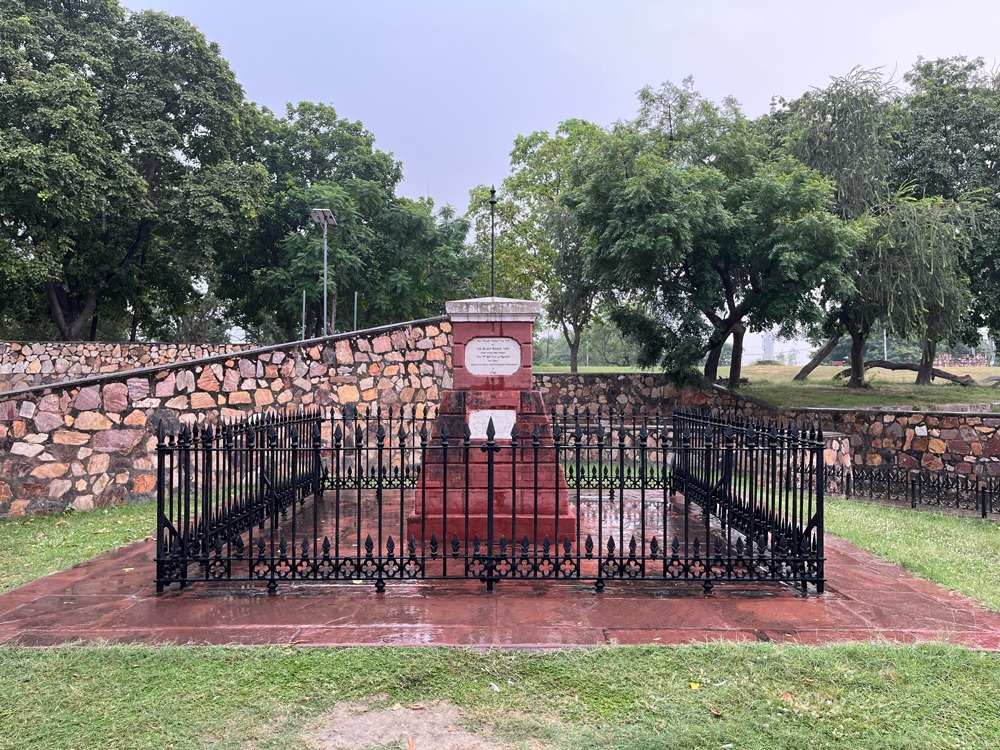 This pillar marks the site of the Kala Amb (black mango tree) near which was fought the third Battle of Panipat
First up was the Kala Amb Park, or Panipat War Memorial. This is where one of the 18th century’s bloodiest battles was fought, the Third battle of Panipat.
The battlefield itself is about ten kilometers away from Panipat town, down narrow country roads and past verdant paddy fields. The land around was as flat as a pancake, the kind of open terrain ideal for deploying large armies of cavalry and elephants. This was the reason why Panipat was so strategically important for battles, along with its closeness to Delhi being ideal for logistics.
It had just stopped raining when I entered the park, and I could smell the rain on dry ground. Women were working in the surrounding fields, their heads covered in colorful dupattas, while white egrets pecked the soil for worms. It was serene and peaceful, very different from what it must have been like on January 14, 1761.
A plaque at the entrance provides useful context for Panipat’s three famous battles: Babur’s defeat of Ibrahim Lodi in 1526 established Mughal rule; Akbar’s victory over Hemu in 1556 secured it; and Ahmad Shah Abdali’s defeat of the Marathas in 1761 helped create a political vacuum eventually exploited by the British.
The bloodiest was Panipat’s third battle, fought here, between the Afghan and Maratha forces. According to a local myth, a mango tree on the battlefield turned black with the blood of soldiers, giving the site its name; Kala Amb. The ASI has erected a small commemorative pillar around where it is believed the tree stood.
I stood beside this pillar, trying to imagine the thunder and fury of the 1761 battle.
For three months the armies had faced each other warily, skirmishing and disrupting each other’s supply lines. Finally – on January 14, the day of “Makar Sankranti” and considered auspicious – the Marathas decided to take the initiative.
Initially the Marathas, led by Sadashivrao Bhau and Vishwasrao (the Peshwa’s son), managed to gain the upper hand. But by afternoon both the Maratha leaders had fallen fighting on the battlefield, and once this news spread among the troops, Maratha cohesion began to collapse. Abdali’s forces now seized the momentum and in the chaos that followed, thousands of Maratha soldiers were killed while retreating.
I stood under the swollen skies, just me and a few other visitors, in awe of the fact that this is where one of those “hold your breath” moments in Indian history happened. Had it not been for the ASI, this location too may have disappeared from history.
Next, the quietly evocative tomb of Ibrahim Lodi
In a small park in the middle of old Panipat town lies the tomb of Delhi Sultan Ibrahim Lodi, killed by Babur’s forces at the first battle of Panipat.
Lodi’s death was hugely significant. It marked the end of the Delhi Sultanate and the beginning of Mughal rule in India.
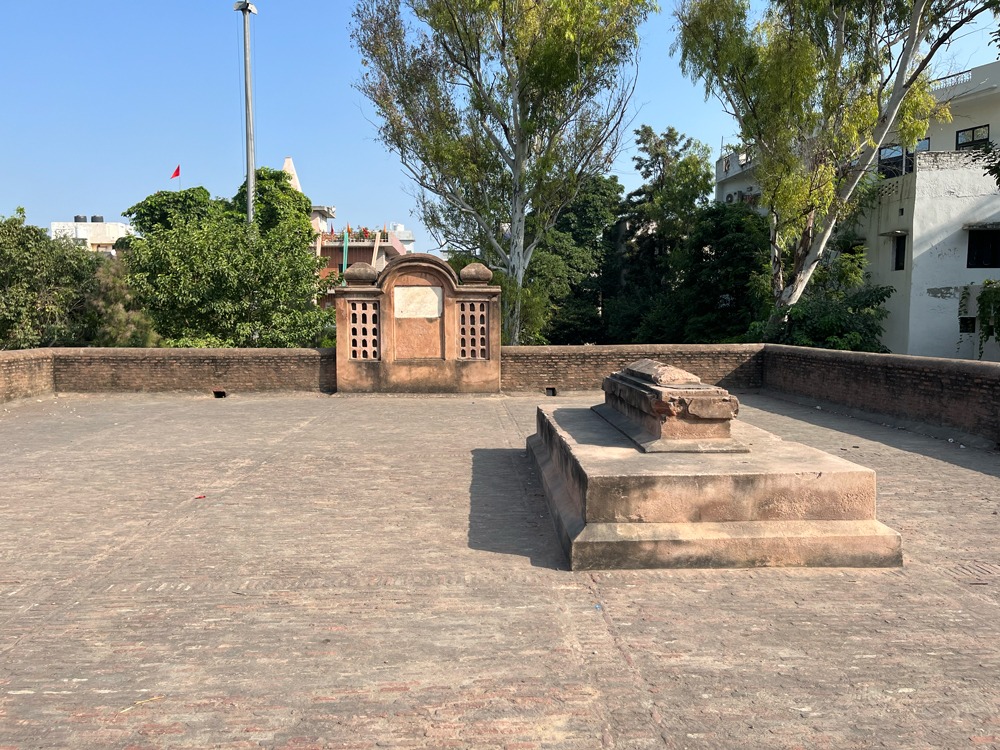 Lonely lies the tomb of Ibrahim Lodi, killed by Babur in the first battle of Panipat. Few monuments so quietly commemorate such a decisive turning point.
 It was early morning when I visited the park and i pushed open its iron gates to enter. Debris from the night before littered the grass. I could see a few swings, an open-air gym, and, given the historical importance of what lay here, statues of fierce looking soldiers in armor who looked central Asian in appearance (perhaps a nod to Babur’s forces…).
In the middle of this small park, on a raised platform and surrounded by domestic three-storey flats, was the modest tomb of Ibrahim Lodi.
I was surprised at how humble the small, rectangular grave was. Ibrahim Lodi (1480-1526) had bossed the Delhi Sultanate for a decade, his empire stretching from Punjab to Bihar to Gwalior. If he had not died on that fateful day at Panipat, the Mughals may never have gained a toehold, and much would have changed in Indian history. I thought to myself; there are very few monuments that so quietly commemorate such a decisive turning point.
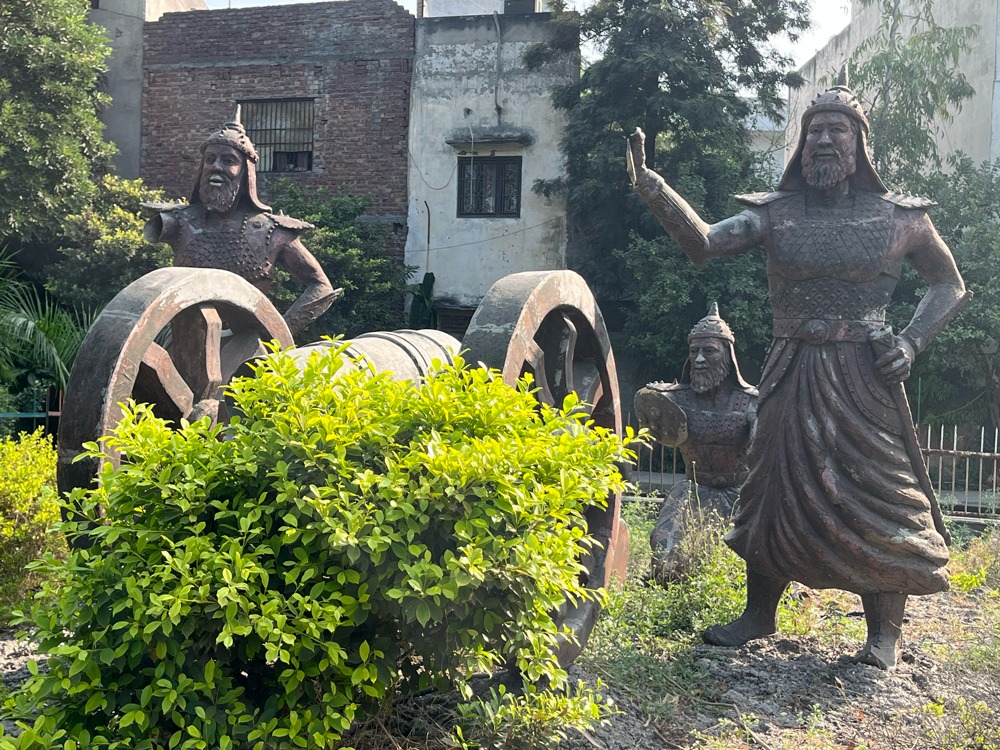 Soldiers in scale armor and conical helmets, with beards and robes; depicting central-Asian warriors of the time.
Babur writes at length about Ibrahim Lodi in his memoirs, the Babur Nama. Initially he was not a fan, describing Lodi as… “ruled by avarice and had a craving insatiable to pile coin on coin. He was an unproven brave; he provided nothing for his military operations, he perfected nothing, nor stand, nor move, nor fight”*
But by the end of the battle, as his foe lay dead on the battlefield, Babur changed his mind. To quote from Babur Nama again “…Ibrahim was thought to have fled…we passed through his camp, looking into his own enclosure…it was the afternoon prayer when Khalifa’s younger brother-in-law Tahir Tibri, who found Ibrahim’s body in a heap of dead, brought in his head” *
The man whose head was brought to Babur now rests in his unadorned grave, with a simple marble slab inscribed in Persian to remember him. It is perhaps understandable. Lodi had died suddenly on the battlefield, with no successor to build him an elaborate mausoleum. Even what we see today is not original, for the British administration, while widening the Grand Trunk Road, had rebuilt the grave on this platform.
Panipat’s spiritual heart; the magic of Devi Mandir and Dargah Bu Ali Shah Qalandar
Set deep within the cobbled winding lanes of Panipat are two sacred places that tell a very different story of the city: not of battlefields and empires but of faith and continuity.
I visited the Devi temple first, where Sadashivrao Bhau is believed to have prayed before facing Abdali’s forces at the Third Battle of Panipat. A vast open courtyard, its marble floor polished smooth by worshippers’ feet, leads to a series of small shrines housing different deities: Hanuman, Ganesh, Lord Shiva, Radha and Krishna, Ram and Sita, Goddess Durga.
Devotees were moving from shrine to shrine, hands folded in prayer. I joined them, while the smell of incense and marigold garlands filled the air and priests chanted mantras to the continuous peal of temple bells.
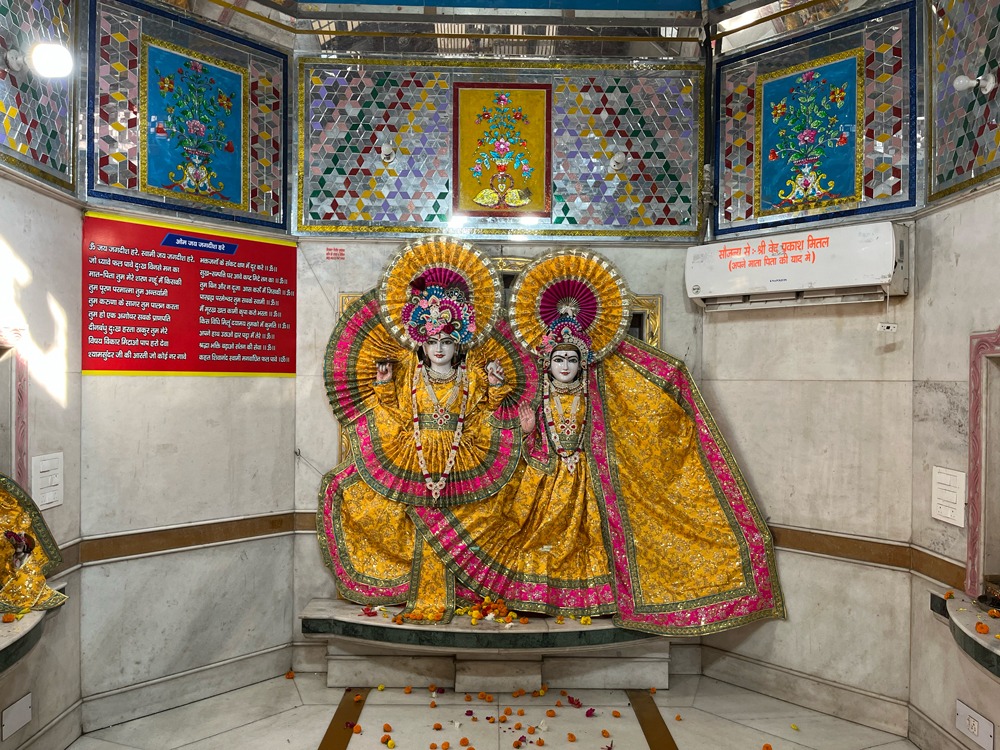 The Radha Krishna shrine within the Devi Mandir complex
A short walk from here is the Dargah Bu Ali Shah Qalandar, its approach lined with stalls selling baskets of rose petals and chadors and neat packets of puffed rice.
The Sufi saint Ali Shah Qalandar (the “bu” in his title refers to “Khusbu”, as in “the perfumed smell of Ali”) was born locally in Panipat in the early 1200s, at a time when Sufism had started flourishing in India. He was a contemporary of Delhi’s Nizamuddin Auliya and there are stories of Amir Khusro visiting him at this dargah.
Besides the saint himself, there are other graves within the compound including, interestingly – in an adjoining red sandstone building – the Mughal General Mahabat Khan who built parts of this complex. This is the same Mahabat Khan who infamously led a coup against Emperor Jehangir by dramatically kidnapping the emperor as hostage, before being tricked into defeat by Nur Jahan’s political maneuvering.
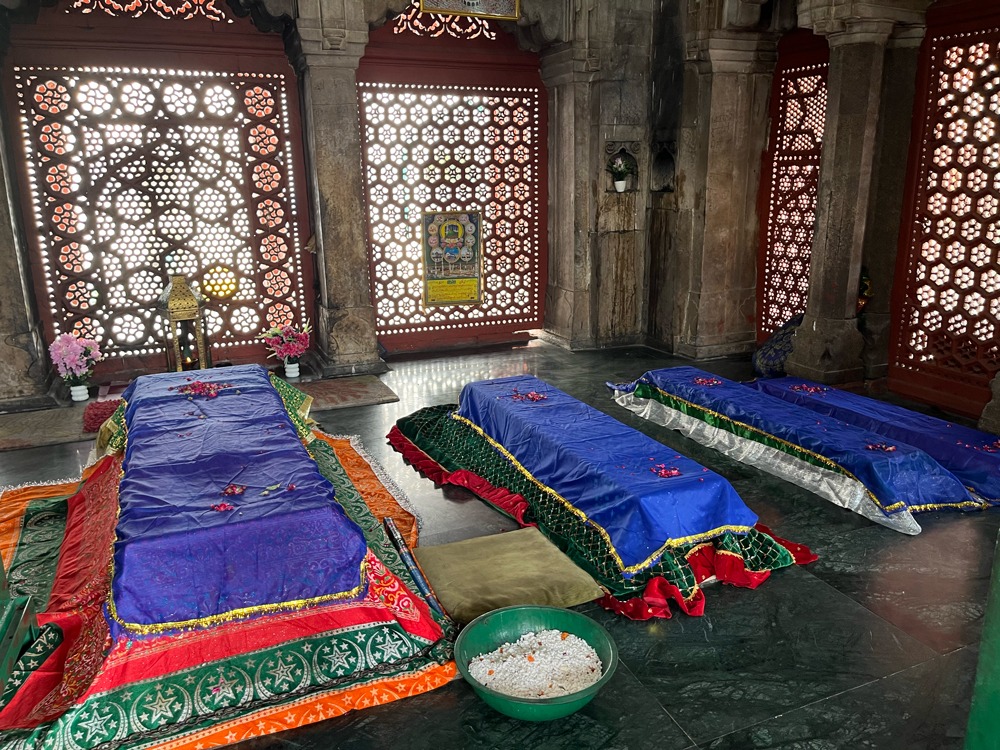 Mahabat Khan’s grave is covered in blue and green chadors, close to the Sufi saint Bu Ali Shah Qalandar
When I visited, there were two young qawwali singers in the forecourt, dressed in kurtas and caps, with one playing the harmonium and the other a dholak. I wanted to hear their stories, but by the time I reached them they had disappeared for a break, leaving their instruments lying quietly on the carpet.
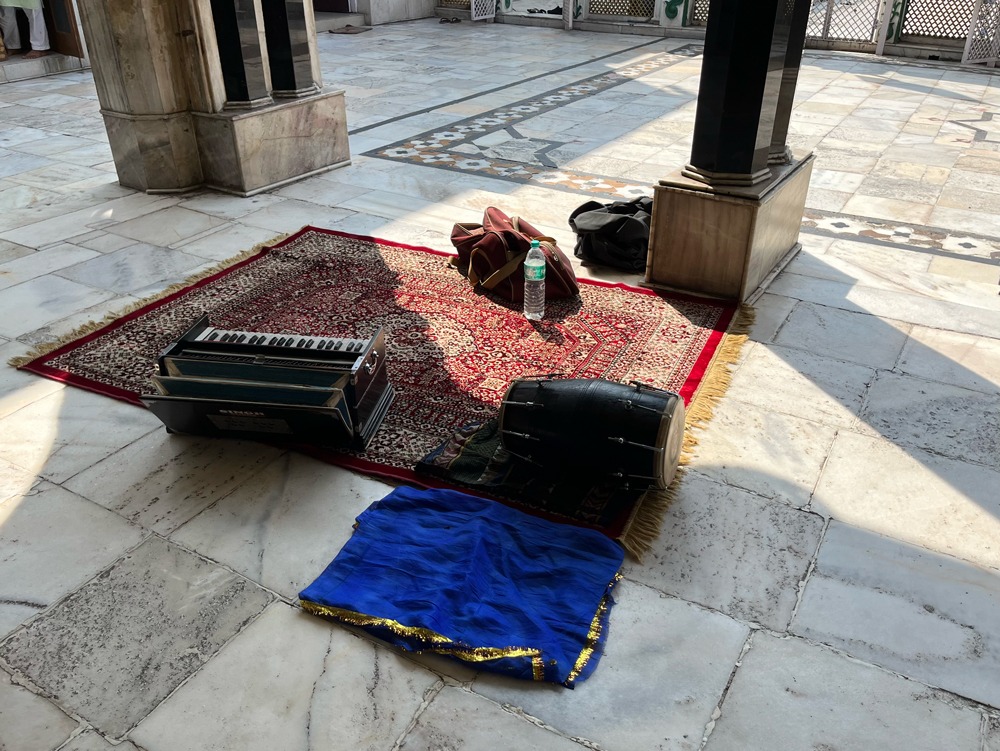 Break time: quietly lie the qawwali instruments after “dam a dam mast qalandar”
I let the sights and sounds of the dargah wash over me. Dervishes in green robes and with flowing hair and beards, sitting in quiet thought. An iron grill beside the saint’s tomb covered in locks (devotees place a lock and keep the keys, opening the lock when their wish is fulfilled). Superb stone inlay work on the walls of the dargah, of which I took many photos.
I picked a black mannat string from a stall, touched it to the saints’ grave and had it tied to my wrist. Having now sought blessings from all the Gods, I was ready to discover the next of Panipat’s attractions.
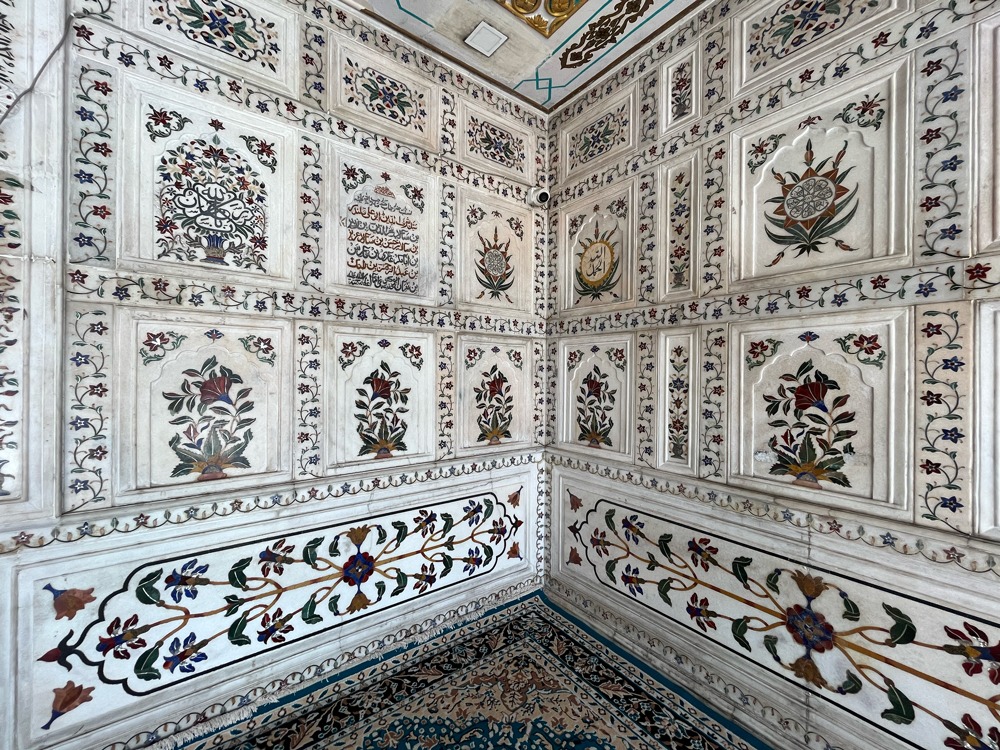 Beautiful stone inlay work cover the walls of the dargah
The Kabuli Bagh Mosque is the first Mughal monument in India
Babur built this mosque in 1526, after the first battle of Panipat, to commemorate his victory over Ibrahim Lodi. Historians often describe it as the first Mughal monument in India.
Kabuli Bagh is especially fascinating for a history-buff, because it catches Mughal architecture almost at the instant it arrived in India. There are many small details to savor, but one must know what to look for.
The entrance gate itself is worth observing. Built of red sandstone, its carved medallions and inscriptions contain fascinating clues to the architecture that the Mughals would develop in India.
First, immediately above the main doorway, in the most prominent of locations, is a six-pointed star, much like the Star of David. One can see the same design in many later Mughal monuments (Humayun’s tomb, Agra Fort, Purana Qila), leaving tourists wondering on a possible Jewish connection. But this is in fact the Khatam Sulayman, or seal of Solomon, part of Islamic art for centuries. And used here by the Mughals for the first time in India.
Next, on either side of the entrance arch, are two lotus motifs. This too became extremely familiar in Mughal architecture. One wouldn’t expect Babur to adopt Indian motifs so quickly. But as this shows, as soon as Babur arrived in India, he relied on Indian craftsmen and stonecutters to construct his buildings, leading to this quick blending of traditions. Babur even refers to this in the Babur Nama.
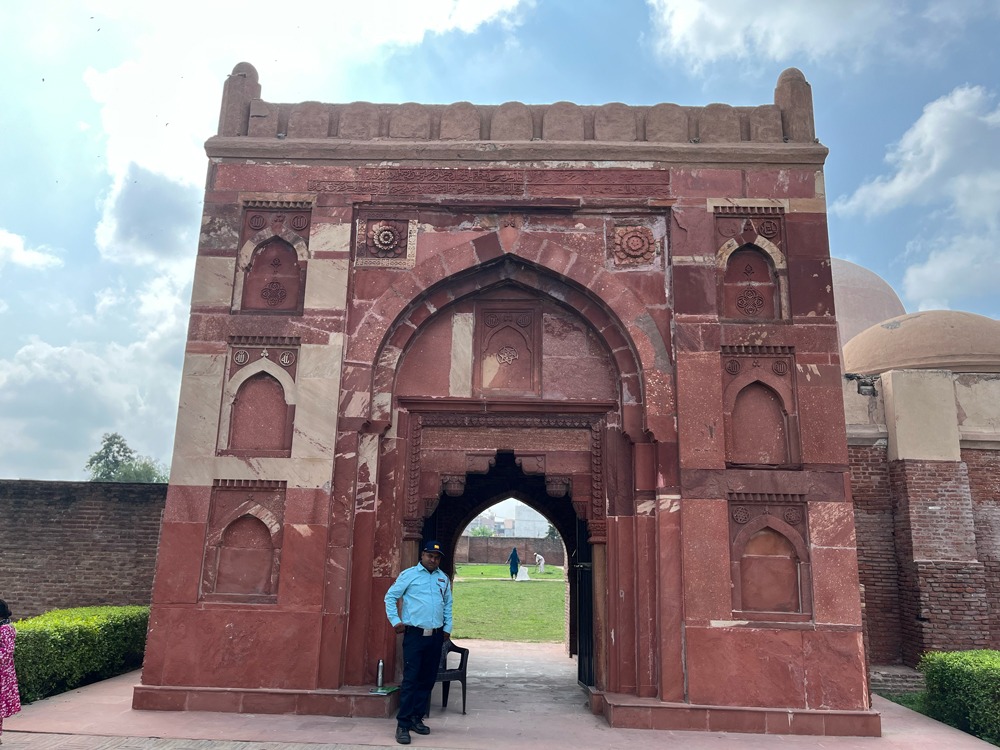 Babur’s red-sandstone entrance doorway features many symbols worth looking out for
Inside the gate is a large patch of lawn (originally a garden?) with a water tank at the center for ablutions. and the mosque rising behind it. Again, the façade of the mosque tells a story; it looks Central Asian, like something one would expect in Samarkand.
The building’s most striking element is its enormous rectangular frame, called a pishtaq, behind which is the central dome. This is typical of Persian and Timurid mosque architecture, of the kind we see in the monumental buildings of Samarkand and Herat. So why would Babur build this in Panipat? It speaks of his cultural roots; being born in Fergana, repeatedly fighting for Samarkand, and ruling from Kabul for twenty years before venturing to India. Babur’s architectural imagination was rooted in Persian styles, so thus a little stamp of that Central Asian world in Panipat.
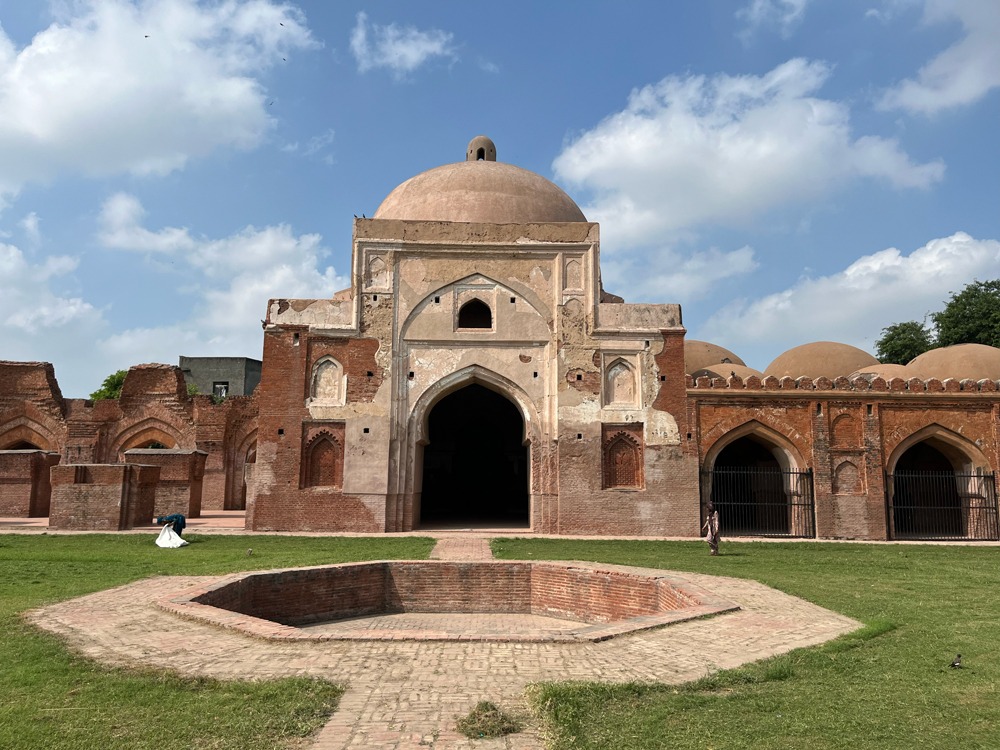 A Samarkand style mosque in Panipat with its enormous rectangular Pishtaq
I stepped inside the mosque, its vast dome rising above me. In front, on the western wall, was the mihrab (a niche in the wall that indicates the direction of Mecca). An inscription above the mihrab, in Persian, explicitly states:
“The foundation of the mosque of His Majesty Zahir ud din Muhammad Babur Padshah Ghazi”
In the cool half-light of the prayer hall, I imagined Babur himself praying here, at the place where his new Indian destiny began. I had read much about this extraordinary man, not least through his own words in the Babur Nama. Standing where Babur may once have stood, how would I remember him? As an unusually self-aware man: a warrior, a gardener who could take great pleasure in a beautiful flower or view, sentimental poet, a drinker, a father.
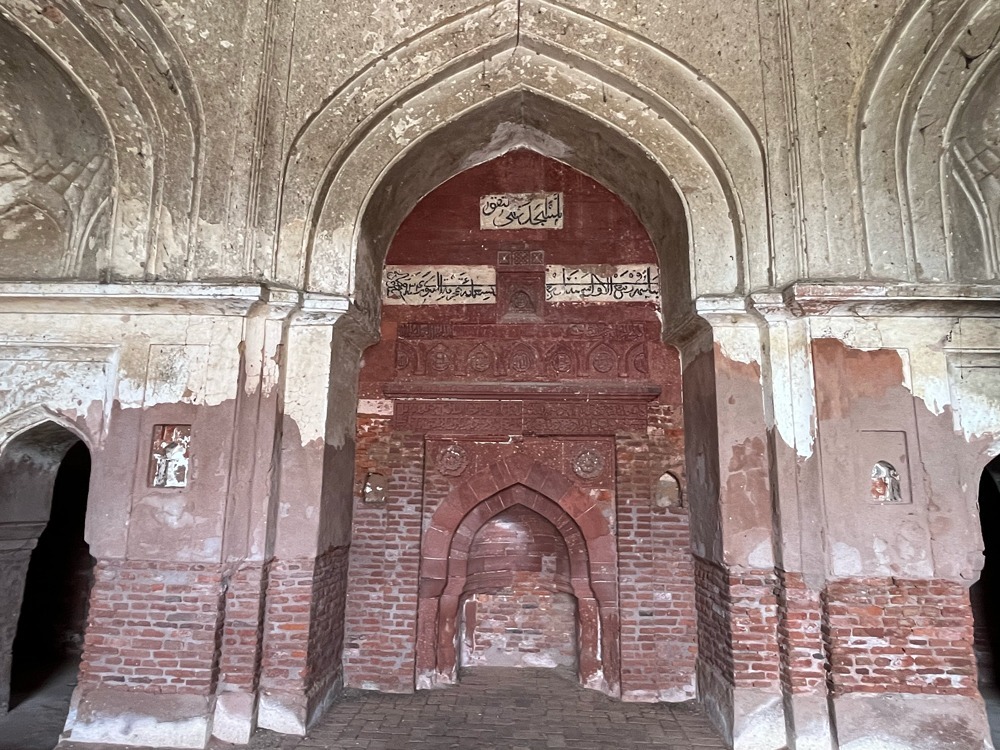 The mihrab above which a Persian inscription identifies “Babur Padshah Ghazi” as the person who commissioned this mosque
Check out the Panipat Museum as your last stop
To round off your visit, you could stop at the Panipat Museum on the way out. It has a typical sarkaari, slightly musty ambience, but nice displays: of weapons used in battle (including mini cannons mounted on the backs of camels), armor-clad Maratha and Afghan soldiers, letters from Sadhashiv Bhau to the Peshwa, a door frame believed to be carved from the battlefield’s Kala Amb tree.
So, what did I make of my action-packed dive into historical (and spiritual) Panipat?
For all its enormous significance to Indian history, Panipat can do much more to conserve and showcase its heritage. Most of its attractions are clustered within a few kilometers of the old town and could easily form a wonderful heritage trail drawing students, tourists and history enthusiasts – especially with Delhi barely two hours away. Panipat has the history, which could be leveraged very well for the local economy. But that needs a vision and a will to make it happen.
How to get here:
- From Delhi, take the NH44 north to Panipat. The drive is about 90 minutes.
- I stayed overnight at the Sarovar Hotel which is located along the highway and convenient to use as a base
- Most of the attractions are in old Panipat town. You will need a vehicle (car, auto) to get around as the lanes are narrow, and be prepared for walking.
- The Kala Amb Park is about 10 kms out of town with unfortunately very limited signage (use Google maps)
- The Panipat Museum is also 10 kms away but in the other direction, near the Panipat Oil Refinery
Sources:
-
- “Cannons Versus Elephants; The Battles of Panipat”. By Col. Harjeet Singh (Retd). Published by Pentagon Press.
- Babur Nama (translated by Annette Susannah Beveridge) – Vol 1 and 2
