
13 Oct Who was Najaf Khan? A Man Who Zigged When Others Zagged
…his tomb in Delhi remains half-finished, much like his life’s work.
If you’re a Delhi resident and interested in your city’s backstory, you need to know about Mirza Najaf Khan (1737-82), who occupied an important space in Delhi’s history during a specially turbulent time.
In the mid-1700’s, with the once-dominant Mughals in permanent decline and a host of powerful forces jostling to fill the vacuum – the Jats, Marathas, Rohilla Afghans, British – Najaf Khan was the last great minister of the Mughal throne, fighting valiantly to restore order to a collapsing empire. Before he himself was swallowed by the intrigues of the time.
Today, Najaf Khan’s half-finished tomb in the leafy, up-market colony of Jor Bagh is among Delhi’s most easily accessed heritage sites. But it is also sadly among the least understood.
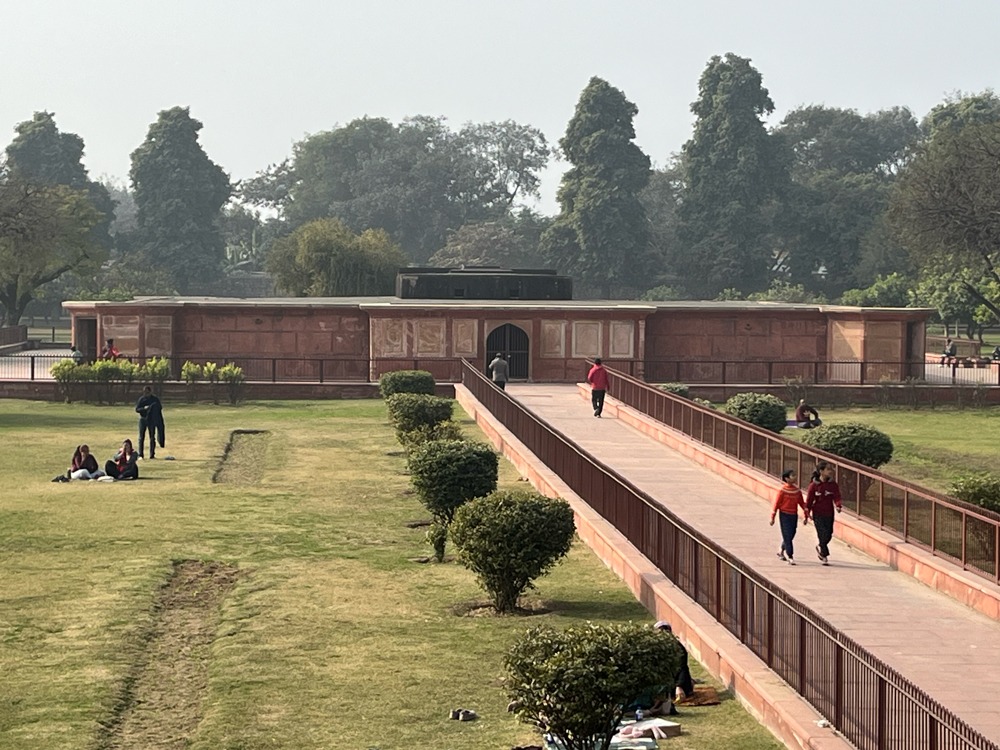 Look, no dome! The unfinished tomb of Najaf Khan is in the middle of a beautifully maintained park in Jorbagh
The fascinating life of Najaf Khan (1737-82)
Born in Isfahan to Persian nobility, where he was imprisoned as a youth by a vengeful Nadir Shah for his connections with the Safavid rulers, Najaf Khan was “released from the dungeon where Nadir Shah had cast him*” on the request of Safdar Jung (the Nawab of Awadh), who’s younger brother Najaf’s sister was married to.
Unsurprisingly, Najaf Khan hastily emigrated to India to join his sister. Here, he entered the service of Mir Qasim, the luckless Bengal Nawab who at the time was in a constant tussle with the British for the control of Bengal.
Najaf made an immediate impact on the battlefield, catching the eye of the English, who made him a series of tempting offers to join their service instead. Najaf did join them, but only after the battle of Buxar (1764), when it was clear that the cause of his master was comprehensively lost. It was with the English, at Allahabad, that Najaf mastered the techniques of European warfare which served him so well in his later career.
Also at Allahabad at the time was the Mughal Emperor Shah Alam, under the protection of the East India Company. Shah Alam was desperate to get back to Delhi, and when the Marathas offered to escort him back and restore him to the throne, Najaf Khan was asked to accompany the Emperor and given an amount of Rs 50,000 to equip his contingent for the march.
Najaf comes to Delhi, and gradually takes control
On a cold January in 1772, Shah Alam re-entered Delhi as Emperor, with Najaf Khan.
The odds were heavily stacked against the Mughal Emperor. The treasury was empty, the army’s pay in arrears, and the palace and capital had repeatedly been looted. One of Shah Alam’s first actions was the appointing of two senior ministers; Najaf Khan and Abdul Ahad Khan.
For Najaf, this was a poisoned chalice. Ahad Khan, from Kashmir, was not an ally. Jealous of Najaf’s military successes, Ahad plotted and intrigued,… “moving his pawns on the political chessboard for checkmating his martial rival**”.
Ahad constantly reminded Shah Alam that Najaf Khan was a Shia. All sorts of suspicions were sown in the Emperor’s mind; what would happen if Najaf teamed up with the Awadh Nawabs, who were also Shias? And for all of Najaf’s military victories to secure Delhi, had it gained any additional revenue for the crown…or been appropriated by Najaf to grow his army?
Najaf Khan, on his part, kept notching up military victories. He had built a powerful army of 90,000, recruiting a host of battle-hardened European mercenaries – among them Walter Reimhartd “Samru”, the Frenchman Rene Madec and Swiss adventurer Antoine Polier – to modernise and discipline his troops. His string of battlefield successes included victories over the Rohillas, the Jats, the conquering of Agra Fort and Aligarh. He also constructed a strong fort for the defence of Delhi, in Najafgarh, an area that now bears his name.
Ultimately, Shah Alam was wise enough to see through the smokescreen created by Najaf’s unworthy rivals, and recognise his worth. In 1779, seven years after entering Delhi, Najaf was appointed vakil and put in charge of both the administration and the army.
And that was the beginning of the end for Najaf
There is a saying in management theory, of “being promoted beyond your level of competence”. Perhaps this was true for Najaf Khan. For as soon as he was appointed vakil, began his one-way descent to self-destruction.
Rarely has a man lost so much so soon.
Najaf Khan held the regency of Delhi for just over two years, till his death in 1782. On becoming vakil, he shifted his residence to a mansion in Delhi near Ajmeri gate, which ominously “proved a grave for both his body and his reputation”. He never left the city again on either tours or campaigns.
The well-known historian Jadunath Sarkar describes the events that played out…“the serpent that caused his fall was Latafat Ali Khan, a eunuch general formerly employed in Oudh service and a brother Shia. This man introduced to Najaf Khan’s notice a woman of bewitching fascination but abandoned character whom Latafat had wedded; and she, entering Najaf Khan’s private wine parties as a handmaid in attendance, soon made herself his mistress**”
In a script similar to a B-grade Bollywood movie, the once admired and seasoned soldier, who had been a paradigm of discipline on the battlefield, dissolved into the unruly and fuddled lifestyle of a nawab.
The life of excess quickly took its toll. Not only did the administration go to pieces, but Najaf fell constantly ill and eventually contracted tuberculosis, dying a painful death when he was just 45 years old.
So, Najaf’s star had flickered briefly over Delhi and was extinguished too soon. Before he could cement his legacy, he was gone. As a general and leader of troops “…he shines in the sunset hues of the dying empire by contrast with the smaller men who mismanaged the state**”. But his greatest failing was that he was no administrator.
According to some historians, Najaf Khan was illiterate, with the vagaries of his early life and imprisonment in Persia not allowing a person of his impressive lineage to complete his formal studies. If that is the case, there have been other unlettered kings as well, the most famous being Emperor Akbar. But, while Akbar the Great “..had the royal gift of choosing the ablest heads for the civil departments, charging them the basic principles of his administration and seeing that his orders were in general being carried out”, Najaf was not up to the task.
So now he rests in Delhi, with his daughter, in a tomb half-finished
When he died, Najaf Khan left behind two little daughters. They remained in his Delhi mansion, looked after by his sister, the respected Khadija Sultan who had taken control of Najaf’s personal belongings, his cash and jewels and the old attendants who guarded his residence.
The elder of the daughters was Fatima, and she was married by Kadija Sultan to Muhammad Shafi, Najaf’s nephew. But in a few years, Shafi was murdered by a rival in the fight for power and Fatima was widowed. Historical records are sparse on details about what happened next with Fatima, but it is she who initiated the construction of her father’s tomb, and chose to be buried next to him when she herself died.
Father and daughter now rest together, surrounded by the big, plush homes of upscale Jorbagh. I visited Najaf Khan’s tomb on a chilly winter morning, with a weak winter sun hanging in a cloudless sky. The park was full with people of all ages, soaking in the sun, lazing on the lawns, snoozing, speaking on mobiles. Children ran on the well maintained grass. Some played badminton. A boy bowled a tennis ball against the medieval walls, catching the rebound.
Not one of these visitors knew who Najaf Khan was. Or the context of this setting.
I walked towards the half-finished red sandstone monument, thinking to myself; is preservation only about maintaining a monument? Is it not about education as well? Well done to ASI for making heritage so accessible. But so much more is required for creating the awareness; for deeper and more meaningful information that visitors can read to educate themselves. Heritage is not only to be seen but also understood.
Why was he buried here? And why is the tomb half-finished?
This area was once part of the estate of the Awadh Nawabs (Safdarjung’s family) who were Shias. This explains the presence of a number of Shia buildings, like the adjoining Karbala (where the Shia community’s annual Tazia procession at Muharram ends, to mourn the martyrdom of Imam Hussain) and also nearby, the enormous Safdarjung’s tomb. Najaf Khan too, being part of Shia who’s-who, found space to be buried here.
The tomb itself is in a large building, rising about 10 feet high, completely symmetrical, with rounded bastions on the four corners. The ornamentation has weathered with time, but one can still see remnants of the original embellishments like lotus designs on the pillars and decorative carvings skirting the roof.
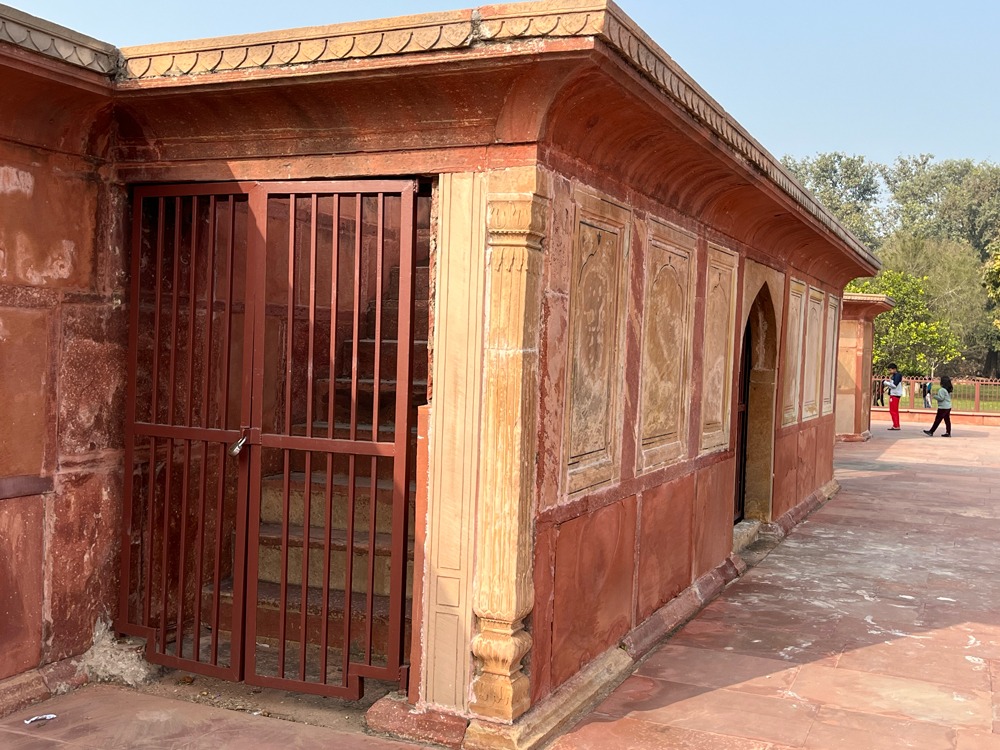 Some ornamentation still survives: lotus design pillars guard a locked entrance to the roof
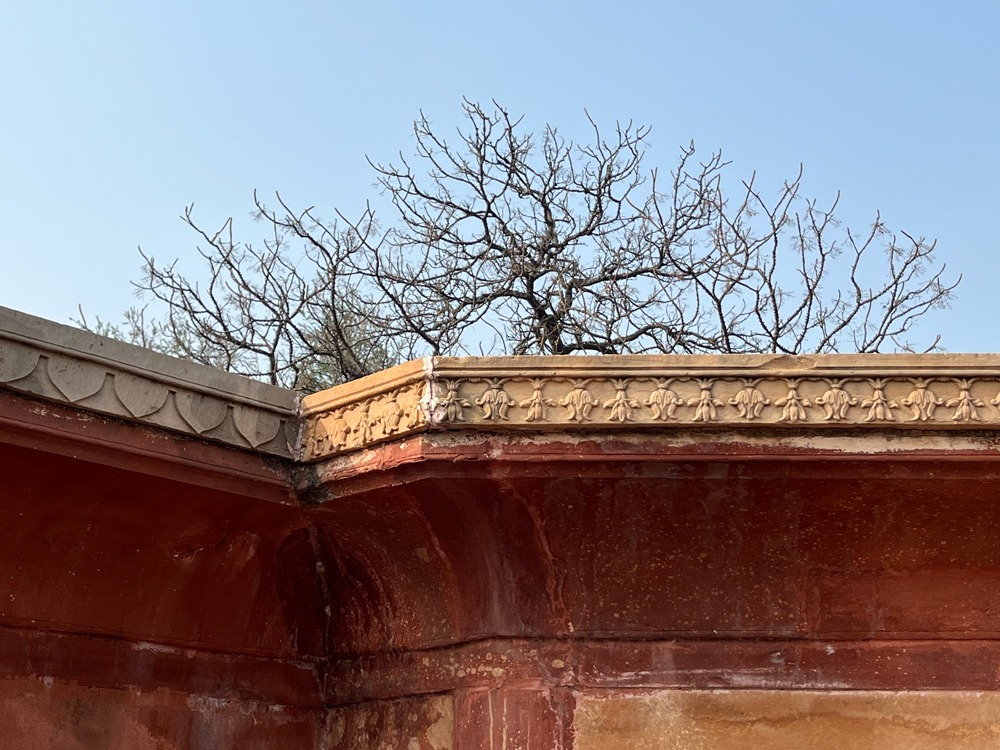 Decorative carvings skirt the roof
At the exact centre of the building – behind a barred door with a stainless steel lock – are the graves of Najaf Khan and Fatima. I peered down the arched corridor that leads to the silent graves, cradling my mobile camera between the iron bars to take photos.
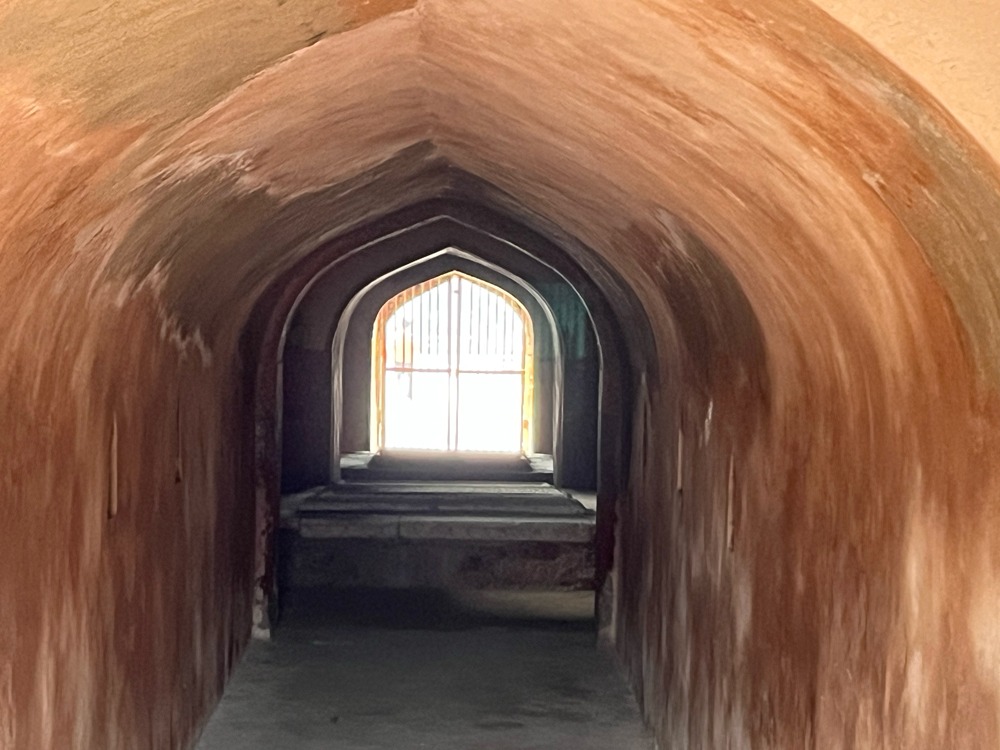 Quietly rest Najaf Khan and Fatima, in the midst of modern day picnickers in Delhi
Normally, these graves would have rested beneath an ornamented dome. But here, the roof is flat and dome-less, which is what gives the structure its half-finished look. It is possible that a grander tomb – like Safdarjung’s – was planned, but a lack of funds and political instability put an end to that.
I wondered what Najaf Khan would have made of this. He lies in a locality that is sprinkled with stunning tombs, like a royal landscape of departed souls, all of them giants of their time. Within walking distance is the red sandstone and marble mausoleum of Safdarjung, Najaf Khan’s brother in law, on who’s request Najaf was released from his Persian prison and found a new life in India. While Safdarjung rests in soaring grandeur, Najaf himself lies in relative obscurity, the walls around him unfinished, much like his life’s work.
But Najaf Khan does have his devoted daughter beside him, and the lush, peaceful surroundings for company.
*G.S. Cheema; “The Forgotten Mughals: A History of the Later Emperors of the House of Babar, 1707-185”. Chapter 36.
**Jadunath Sarkar; “The fall of the Mughal Empire”. Page 28, 137-138, 161
How to get here:
- The closest metro station is Jor Bagh on Aurobindo Marg
- From there, one can walk to Najaf Khan’s tomb or take an auto; down Karbala Road and on to Najaf Khan road
- It is close to the other heritage attractions; Safdarjung Tomb and Lodi Gardens
Information:
- Parking is available on the road outside the complex
- Entry is free
- Toilets available
- Wheelchair friendly.
Sources:
- “The Fall of The Mughal Empire”. Vol III (1771-1788) By Jadunath Sarkar. Published by MC Sarkar & Sons, Kolkata 1952
- The Anarchy. The East India company, Corporate violence, and the Pillage of an Empire”. By William Dalrymple
- “The Forgotten Mughals: A History of the Later Emperors of the House of Babar, 1707-185”. By G.S. Cheema
- “Delhi: A Thousand years of Building”. By Lucy Peck
