
15 Jan The Lost Church of Bandikui
The haunting ruins of a 140-year old church is a throwback to colonial life in a forgotten outpost of the Raj
If you’re seeking a different slice to Rajasthan’s heritage – away from the palaces and forts and baolis of mainstream tourism – plan a visit to the small town of Bandikui.
About an hour’s drive from Jaipur, Bandikui was famous once for its railways. But, as with many other provincial towns in India, its fame rose and fell with the Raj, and this town too faded from the limelight once its colonial masters left.
The railways entered Rajasthan through Bandikui
In 1869, the British formed the Rajputana State Railway and based it at Agra. The plan was to link Agra with Ajmer, and when conducting their survey they decided on making Bandikui a major junction, thrusting a relatively unknown place on to the map.
Bandikui was chosen for its topography, as the land here was flat (unlike the surrounding hills) and the Sanwan river flowed nearby providing a water source for the steam locomotives. Samples of the river water were sent to London for laboratory testing and were deemed fit for steam engines. The original plan was to lay broad-gauge rail lines, but the Viceroy Lord Mayo decided on meter-gauge instead. They were cheaper to build; while the cost for broad gauge was one lac per mile, meter gauge was less at Rupees forty-thousand*.
In April 1874 the first trains steamed into Rajasthan, connecting Agra with Bandikui, and by December of the same year the Delhi section too was opened. Bandikui was now a pivotal junction linking both major cities.
The town quickly developed. A loco shed was constructed for the upkeep of a hundred steam engines. A pump house built for drawing water from the Sanwan river. And a 18-line rail yard constructed for the shunting of trains.
All the top-level railway officials were based at Bandikui; the District Traffic Superintendent, the Executive Engineer, The Loco and Carriage Superintendent, the Chief Medical Officer. About a hundred English and Anglo-Indian families made Bandikui their home, and to house them a railway colony was built over a sprawling 120 acres with schools, a club, an “English bazaar” and a hospital.
The famous singer K.L Saigal reportedly performed here in 1929, at an official’s farewell party. Saigal was a salesman with the Remington Typewriter Company which supplied the railway offices. A source even mentions Saigal working some months for the Bandikui Railway Mail Service, though I could not verify this.
In 1870, the Viceroy Lord Mayo visited Bandikui
Lord Mayo was on his way to Ajmer to attend “The Great Durbar of the Chiefs of Rajpootana”, when he stopped over at Bandikui.
It was at this Ajmer conference that he pitched for the first time the idea of Mayo College:
“…the desire of Her Majesty’s Government is to secure to you and to your successors the full enjoyment of your ancient rights and the exercise of all lawful customs…but in order to enable us fully to carry into effect this our fixed resolve, we must receive from you hearty and cordial assistance…I desire much to invite your assistance to enable me to establish at Ajmere a school or college which should be devoted exclusively to the education of the sons of the Chiefs, Princes, and leading Thakoors of Rajpootana…be assured that we ask you to do all this for other but your own benefit. If we wished you to remain weak, we should say “Be poor, and ignorant, and disorderly”. It is because we wish you to be strong that we desire to see you rich, instructed, and well governed.”**
A bit patronising, but there you are…
Given his interest in public works, specially the railways, it was not surprising that Lord Mayo visited Bandikui. At the same Ajmer durbar, he declared… “the steam vessel and the railroad enable England year by year to enfold India in a closer embrace. But the coils she seeks to entwine around her are not iron fetters, but the golden chains of affection and of peace. The hours of conquest are past; the age of improvement has begun”**
Despite these lofty words, the lure of commerce had a lot to do with his visit. The salt lakes at the nearby town of Sambhar provided a “practically inexhaustible supply of excellent salt”, and Lord Mayo had negotiated treaties with local rulers to obtain its lease and control. Part of the plan was the construction of a railway system that could exploit this asset, increasing the supply of salt to North India and reducing prices.
Bandikui gets its beautiful, soaring church
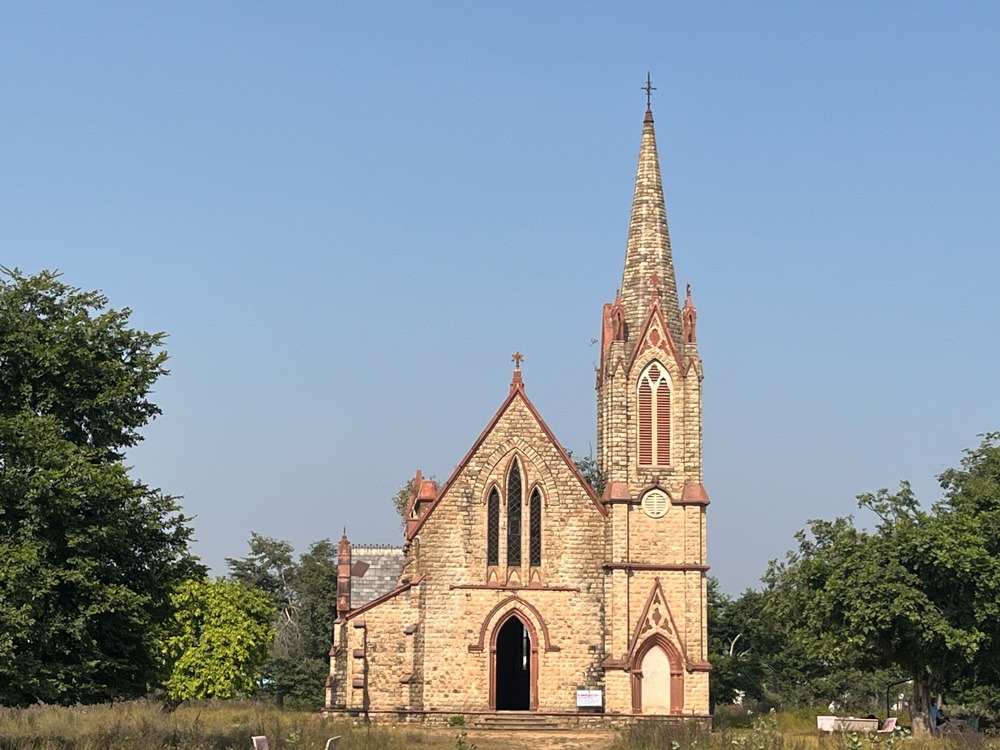 Bandikui’s atmospheric 140-year old church with a soaring steeple, visible from far
The church is now abandoned but retains all its aura and charisma, towering over the railway colony and standing by itself in the middle of a vast compound. Its tall steeple, rising above the trees, is visible from far. I had been told that the church was located on railway land and had taken the precaution of contacting a local railway official in case I needed permission to view it. But I didn’t need that.
As I entered the church grounds, overgrown with vegetation, I met the security guard Umaid Gujjar, who connected me with the caretaker of the church, Richa Williams. Richa is from Bandikui, her mother having been a teacher at the railway school, and as she told me, her parents were married in this church. Her family is one of a handful of Christians left in Bandikui.
Exploring this lovely 140-year old church with Richa was the best way to discover it. Only the main building was intact. The rest of the furniture – pulpits, pews, doors, hinges, windows, stained glass, even the church bell – has all been looted over the years.
We entered the nave of the church, large enough for a congregation of a hundred, but now stripped bare of furniture and with bird droppings covering the floor. High above us, a vaulted wooden roof stretched towards the sky adding grandeur and space. Several of the roof’s wooden slats had come loose and were lying fallen on the floor, allowing bright sunshine to filter through. Pigeons cooed and fluttered around us, nestling in the niches.
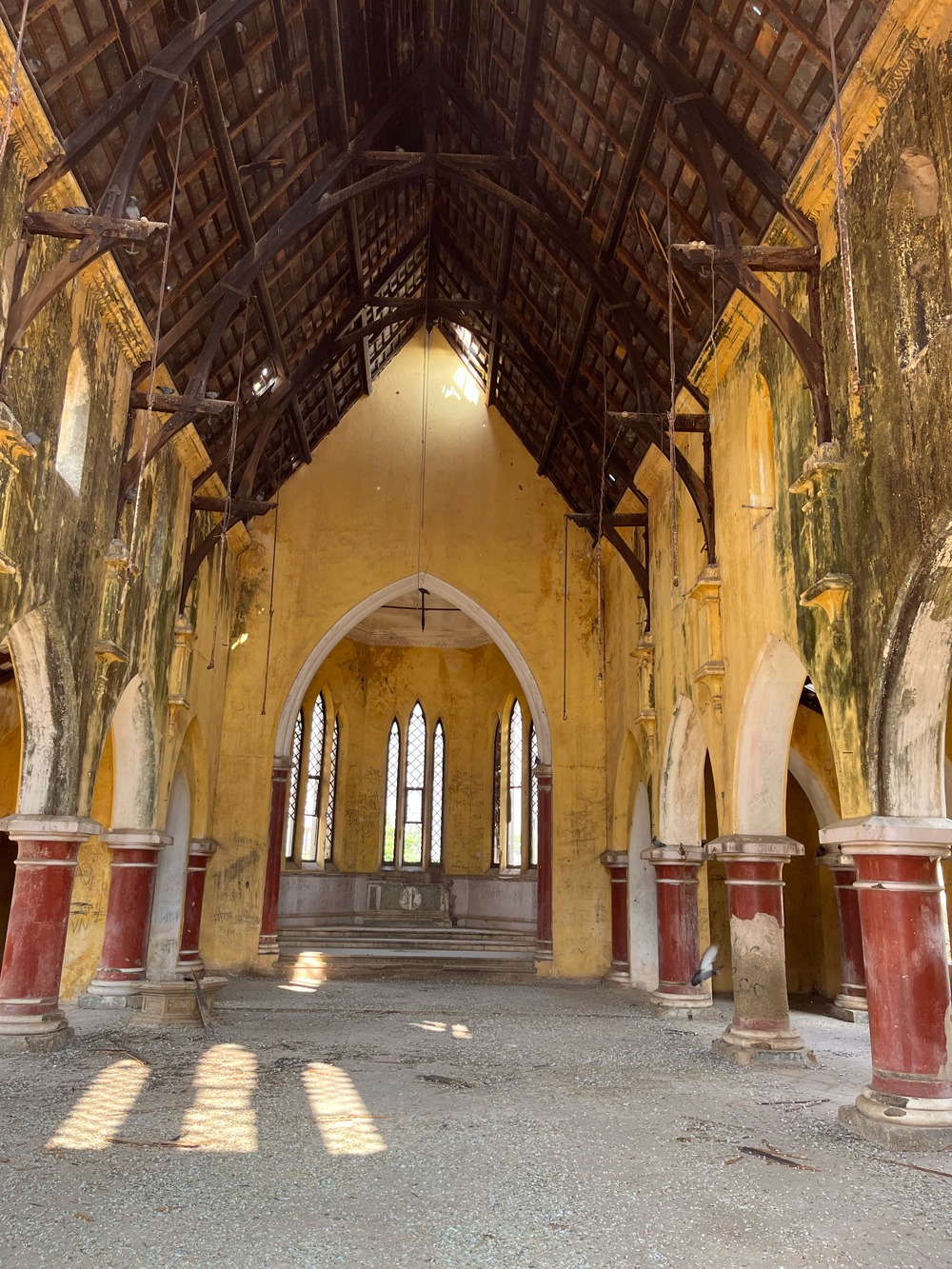 The full-of-atmosphere congregation hall; stripped of its pews, red choona columns,broken slats from a vaulted wooden roof
At the far end of the hall, the alter still had remnants of its original blue stone and a white cross. On either side were small rooms for the vestry and the choir. A broken pulpit, its marble railings long gone, had three small steps for the pastor to climb and deliver his sermons. Richa showed me the baptismal pot, standing mute and discarded in a corner (who was the last baby to be baptised here, I wondered?).
The columns lining the hall had a distinct red colour, that somehow added to the atmosphere and poignancy. I assumed it was red Dholpur stone, of the type used at Delhi’s Red Fort. But Richa scratched out a small piece for me; it was red plaster (choona) instead, cleverly used as decoration.
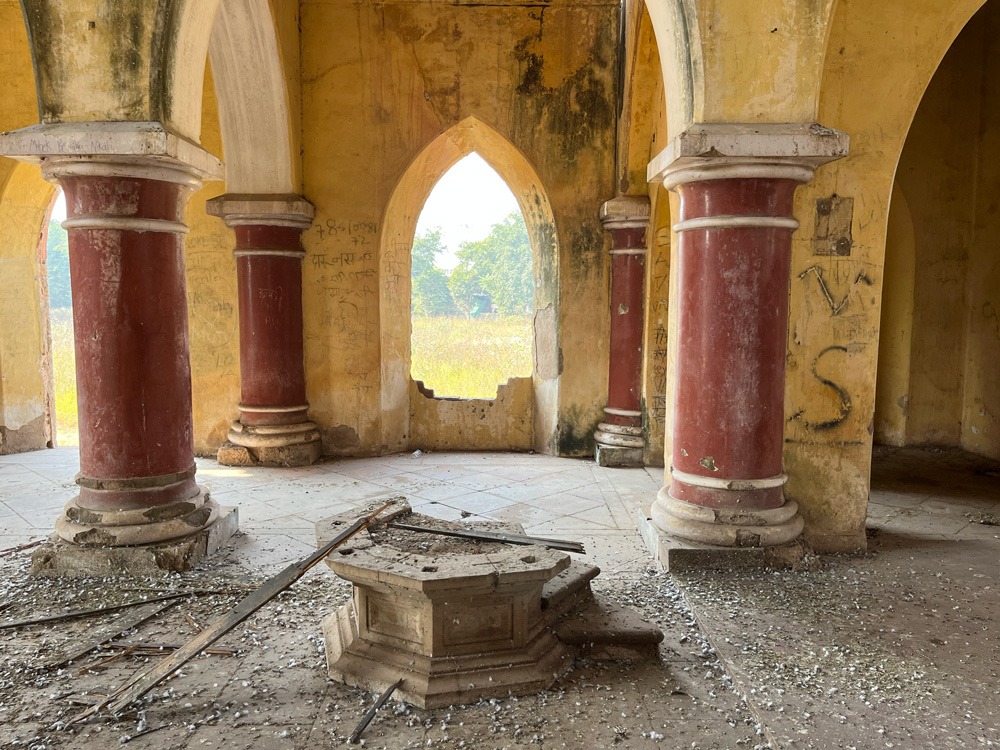 A broken pulpit, its marble railings long gone; sermons once resounded off these walls
From a musty, windowless room beside the main entrance, a set of flimsy iron stairs rose to the floor above and disappeared into a square opening. This was the bell tower. The stairs may remain intact, but what they were built for has gone, for the church bell was stolen some years ago. Richa said she could recover the bell’s original casing, but the pendulum had been cut and sold.
What could these grounds have been like a century ago, when the choir’s voices rang loud and the bells tolled? The history archives I researched mentioned many of Bandikui’s colourful characters, and I imagined them now greeting each other as the church stood solid behind them; Major Peele and Mr Furnivall, the managers in charge when the first trains rolled in. Dr Cheeku, the medical officer who was a “good badminton player”. Dr Hell (strange name for a Doctor…) who would be summoned from Jaipur for emergencies. Miss Spencer, mistress at the Railway School, who died young at 32 and was buried locally. The Reverend Father Louis Macedo, this church’s first Chaplain as it opened its doors and who continued to serve for 30 years. And the one-armed ex-soldier George Remath, who lost an arm in World War 2, Bandikui’s Chief Ticket Collector, always spotted with his trusted servant Moti.
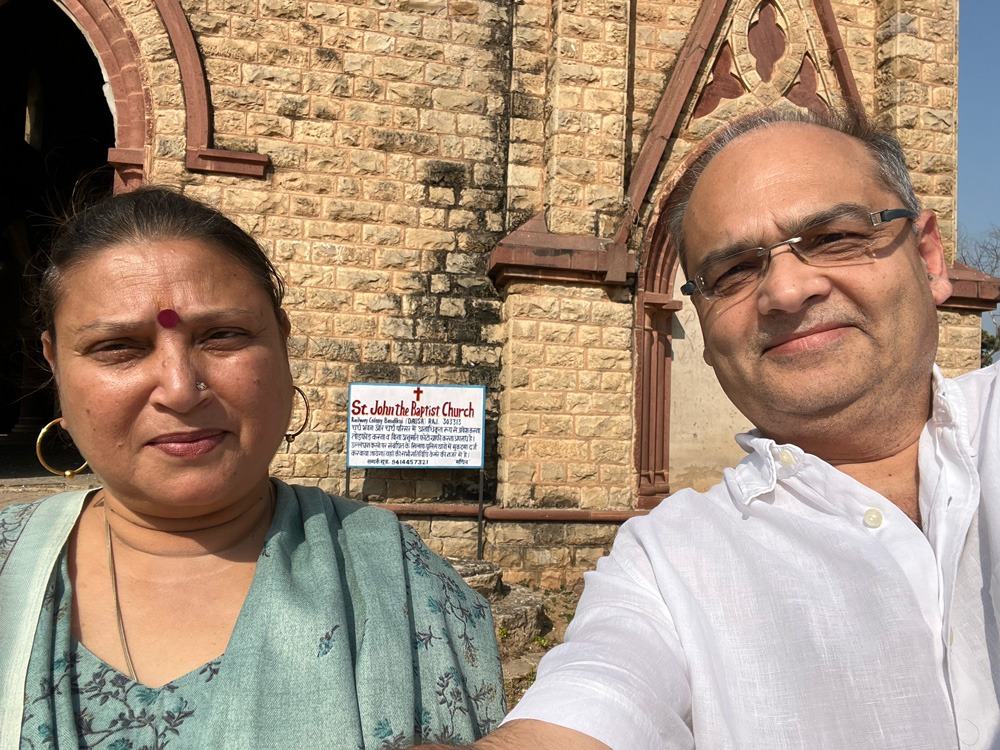 A selfie with Richa Williams in front of the Bandikui church she passionately works to preserve and restore
A second church at Bandikui that few knew about…
While this was a Protestant church, Richa mentioned another nearby; St Francis of Assisi Catholic Church. It was built in the same era, maybe 10 years younger, and was still functioning. It too had stories to tell.
Gujjar ji dropped me on his motorcycle to the gates of the Catholic church. It was such a short one-minute ride, I may as well have walked.
The contrast between the big Protestant church, set within its own vast grounds, and the much smaller and intimate Catholic place of worship was apparent. Maybe it points to a religious fault-line that the East India Company too grappled with.
During the early part of its presence in India, the East India Company discouraged missionaries in its territories, fearing it would upset local populations and interfere with commerce. But that changed with the Charter Act of 1813 which allowed missionaries to operate in British India. The Company had received its royal charter from Queen Elizabeth 1 – who established the Protestant Church of England as the official state church – and so it generally remained a Protestant organization, reflecting the state religion.
Most company officials were Protestants, and so was Lord Mayo. Thus, the church he sanctioned for Bandikui was Protestant, and being a man who was aware that…”in the East, some magnificence and display on the part of the Ruler have in themselves certain elements of power”, the church was built on a fittingly grand scale. Perhaps some years later the Catholic population decided on a smaller church of their own.
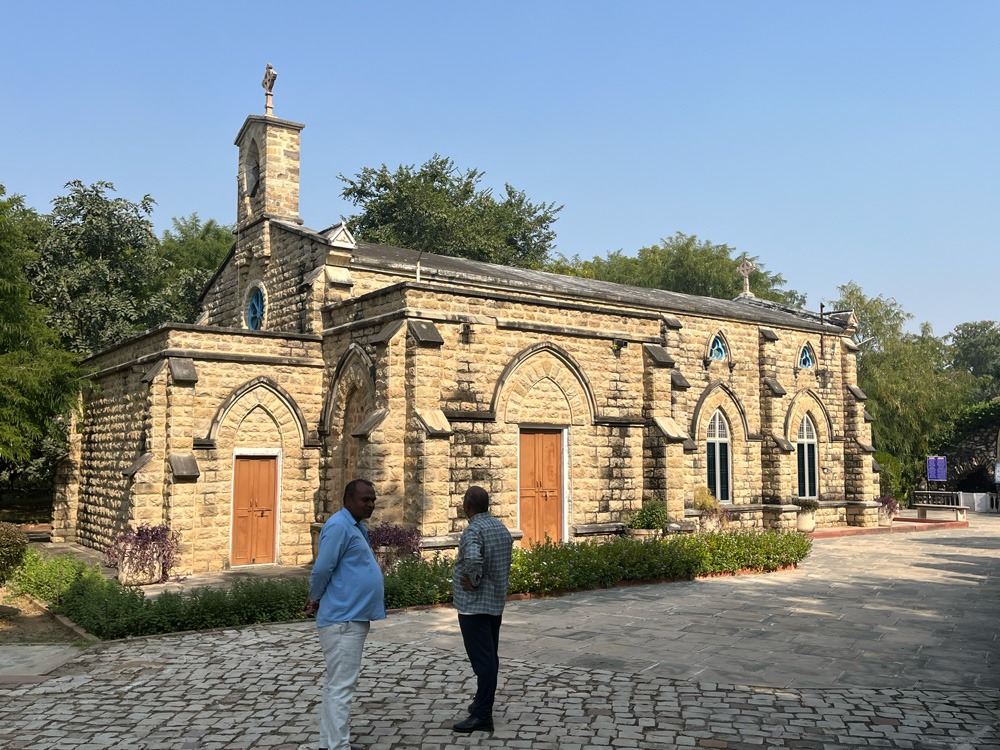 The smaller, intimate Catholic church; built about a decade after its more larger cousin. Gujjar ji and Father Prem in the foreground.
But now, the smaller Catholic church is the only one operational. Ironically, it is the charismatic ruins of St John the Baptist church that caught the notice of heritage-seekers for its off-beat nature and the aura and nostalgia of its setting (which is how I read about it, and decided to visit) while the still-functioning Catholic church, built about a decade later, has remained undiscovered.
I met Father Prem, the parish priest, who lived on the premises. He told me about the few Christian families in town, mainly from Orissa and the Northeast, and the nuns who lived at the nearby St Francis Convent School. They were his regular congregation. Father Prem shared with me a file on Bandikui and this church’s history, and showed me around the church, mentioning that all one sees today was original (including the church bell, unlike its unfortunate neighbour) apart from the windows which needed to be replaced.
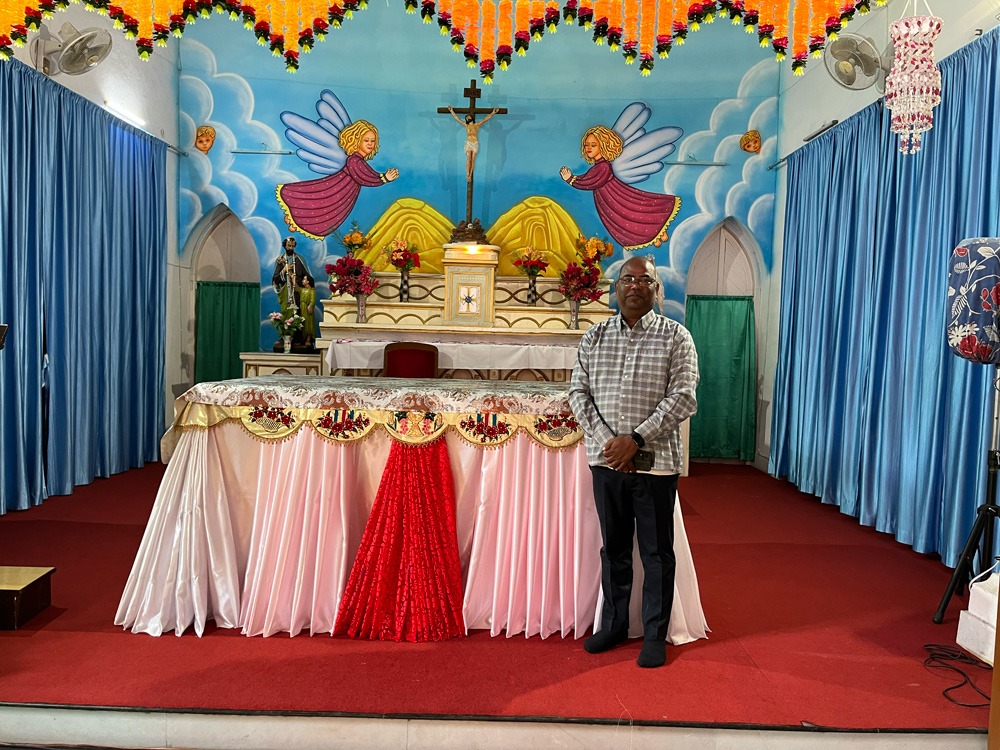
Father Prem, from UP, inside his small and intimate and fully functioning Catholic church
We stood chatting in the afternoon sunshine as I wished goodbye to Richa and Father Prem and Gujjar ji. Back in my car, driving past the railway colony’s Raj-era bungalows that were painted a typical sarkaari yellow, I could reflect on the amazing day that I had; exploring Bandikui’s history and its hauntingly atmospheric church, meeting those working locally at preserving this little-known piece of Rajasthan’s heritage, and – as a complete bonus – discovering another hidden gem of a church as well.
*article by Ram Prasad Sharma on Bandikui’s history (Pragyan Bharti Journal)
**S.R Bakshi; “Viceroyalty of Lord Mayo – Administration in India 1869-72”. Pages 26-28
How to get here:
Bandikui is a 90 minute drive from Jaipur.
Get on to the Bandikui-Jaipur expressway. After about 40 minutes take the exit marked “Dausa and Bandikui” and follow the signs for Bandikui.
Googlemaps does a good job. Search for “Bandikui old church”
The old church is located in Bandikui’s railway colony and the Catholic church is also within walking distance
A tip – Bandikui makes a nice day-trip from Jaipur if included along with a visit to Abhaneri, just a 20-minute drive away. Abhaneri has the well-known Chand Baori stepwell and Harshat Mata temple, tourist sites well worth visiting.
Information:
- Parking is available on the road outside the church
- Entry is free
- No toilets. Not wheelchair friendly.
Sources:
- “Viceroyalty of Lord Mayo: Administration In India 1869-72”. By S.R Bakshi. Published by HK Publishers, Delhi, 1990
- Article by Ram Dayal Sharma in the Pragyan Bharti journal (shared with me by Father Prem)
