
17 Feb Shiekh Chilli’s Tomb at Thanesar
A little-discovered jewel that is waiting to be explored, and easily accessed from Delhi
Thanesar is short drive from Delhi, and has the best preserved historical monuments in Haryana.
I used the holiday of Gandhi Jayanti to make a day-trip there, and was amazed at how much this historic town had to offer. And, how wonderfully preserved and unique its attractions were. Between the lovely museums, stunning Mughal-era monuments and the enormous religious significance of the sacred Brahmo Sarovar lake, I came away very fulfilled.
Shiekh Chilli’s elegant tomb at Thanesar
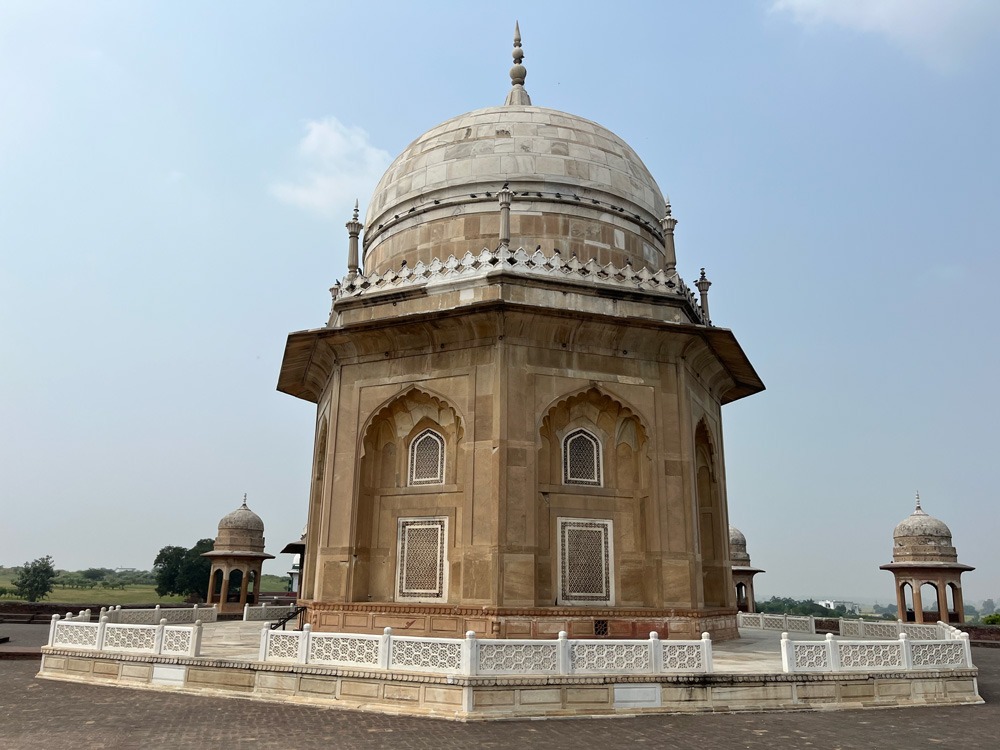 The octagonal-shaped tomb of Shiekh Chilli is one of the most striking in north India, “…deficient neither in beauty nor elegance”
If you grew up in north India like I did, you would have heard the humorous folk-stories of Shiekh Chilli, a day-dreaming buffoonish character who lived in his own make-belief world. But this graceful tomb at Thanesar belongs instead to the Sufi pir Abdur Razzak, who was given the honorific chilli title for frequently performing chillas, a forty-day fast for penance.
Abdur Razzak was the spiritual teacher of the Mughal Prince Dara Shukoh, Shah Jahan’s favoured son who was killed by his brother Aurungzeb in their rivalry over the throne. This is probable, for though the building has no inscription to establish its date, architecturally it is believed to have been constructed around 1650. And moreover, a complex of this size and requiring such maintenance could only have been built with court patronage.
William Barr, a British traveller who visited Thanesar in 1839, described Shiekh Chilli’s tomb as “deficient neither in beauty nor elegance”*. He was not wrong. It is among the most impressive tombs in north India.
These fortress-like walls enclose his tomb, a madrassa, and now…museums
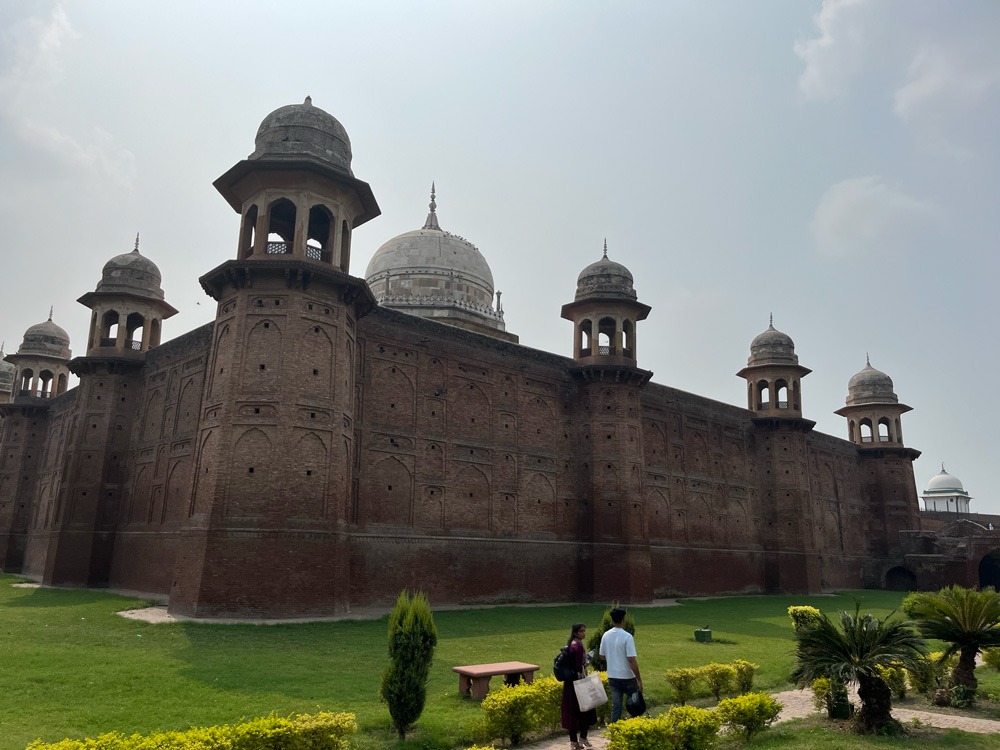 Exceptionally well-maintained fort-like brick walls protect the tomb and madrassa of Shiekh Chilli
First, I must describe the saga of getting in. The ASI in its wisdom had a system of scan-only payments for the Rs 20 entry fee, with no cash, and given the frustratingly poor connectivity there was much hand waving of mobiles to make the internet connections. At least ten people were trying to pay with the guards rushing around to help. Finally one man’s phone connected, and through this kind soul all of us bought our tickets. I offered to pay him Rs 100, but he smilingly accepted only the Rs 20 entry fee. As we all trooped in victoriously, the guard had this lesson to share: “Sir ji, a little cooperation solves all problems”.
I walked up a broad slope and under an arched gate with a Persian inscription above it, and entered an open courtyard that was flanked on each side with rows of rooms. This was the madrassa, and these rooms were the classrooms, libraries and living accommodation for teachers and students. There was a shallow water tank at the centre, which was likely used for ablutions before prayers.
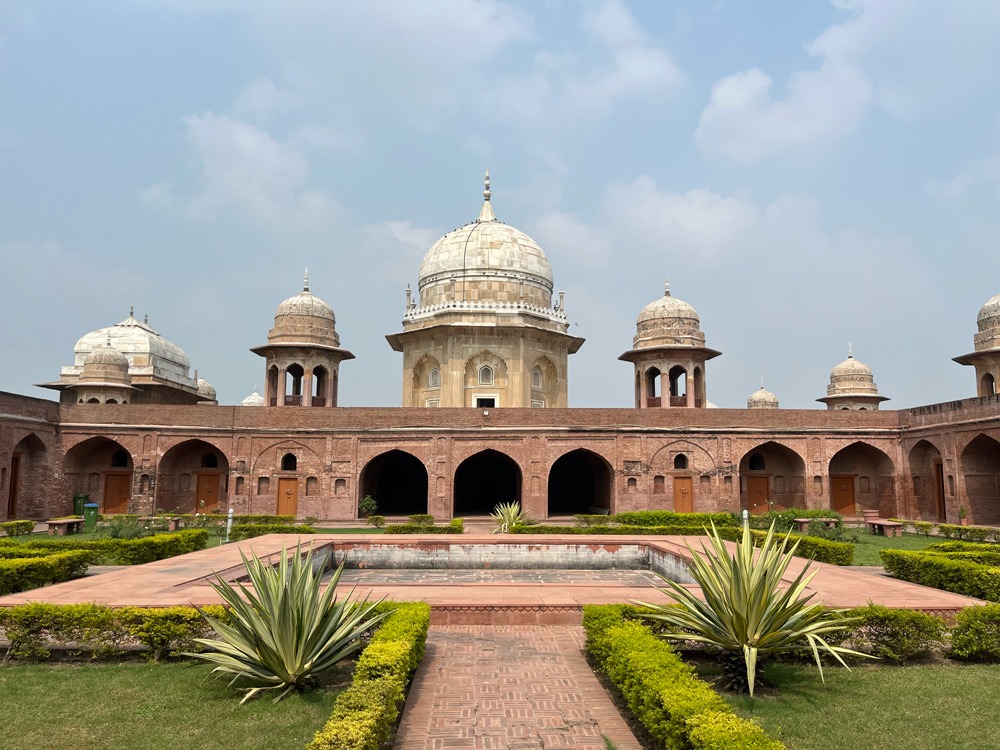 The tomb dominates the madrassa grounds. The shallow tank at the centre of the courtyard was probably used by teachers and students for ablutions before prayers
It was in madrassas like these that the ulema were educated, who then staffed the civil service and judiciary. The historian Subhas Parihar mentions a number of madrassas that still survive from the Sultanate and Mughal periods, including Alauddin Khilji’s at Mehrauli and Feroz Shah Tughlaq’s at Hauz Khas, but the madrassa of Sheikh Chilli is the most impressive.
There was a well-established tradition for madrassas to be attached to a tomb, which was usually of the founder or a great teacher who taught there. This was no different, for attached to the building were the tombs of Shiekh Chilli and his wife.
The graves were below the main ornamental terrace. I stepped through an opening in the wall and down a narrow, bricked passageway which disappeared into the darkness. I needed to feel my way, seeking gingerly for footholds and letting my eyes adjust to the dark, as alarmed pigeons fluttered around me. At the end of passage was the grave chamber, about 15 feet high, where there were four graves; of Shiekh Chilli and his wife and perhaps some close disciples.
A single bulb illuminated the domed vault. I could see niches in the walls that were used in the past for candles. I was alone. In a while one more man walked in, feeling his way like I did. We spoke, with our voices echoing in the dark chamber and sounding louder than usual. He was from Dehra Dun.
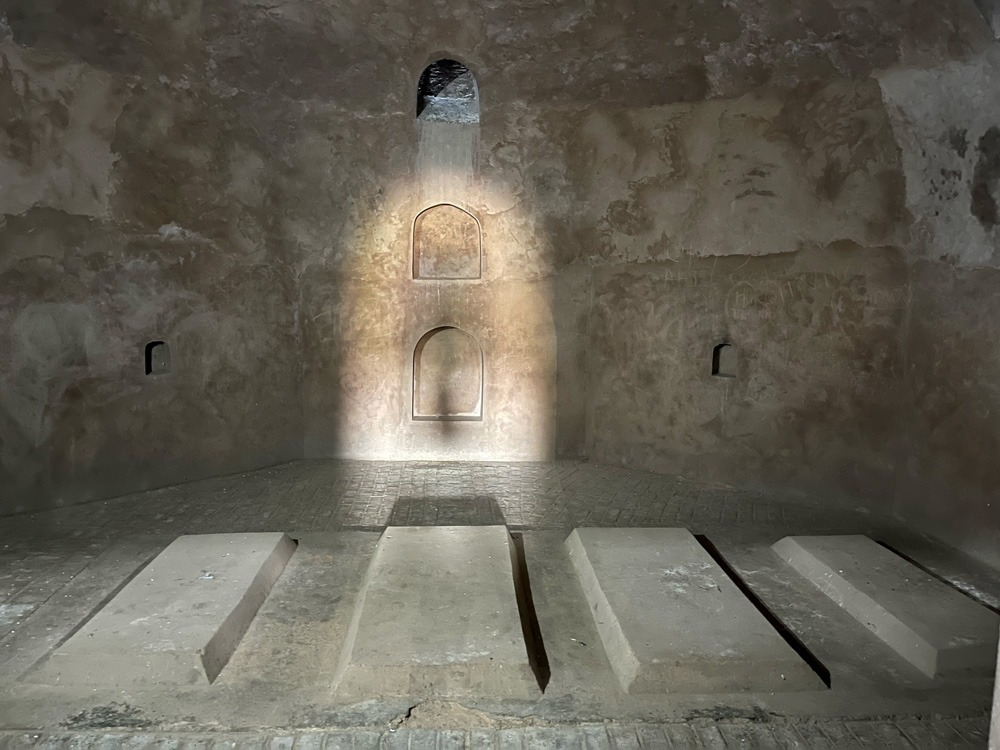 Inside the tomb chamber with niches in the walls for candles; quiet rests Shiekh Chilli and his wife
An decorated terrace with a pearl shaped dome, carved trelliswork, and a museum to visit
I climbed up to the terrace, bathed in bright sunshine with the gorgeous tomb at its centre. A knee-high marble railing in white jaali surrounded its octagonal shape. Each of the building’s eight faces were adorned with floral trellis work and cusped arches that we know was a feature of Shah Jahan’s period. The open platform was studded with ornamental chattris that provided cool shade, inviting one to sit.
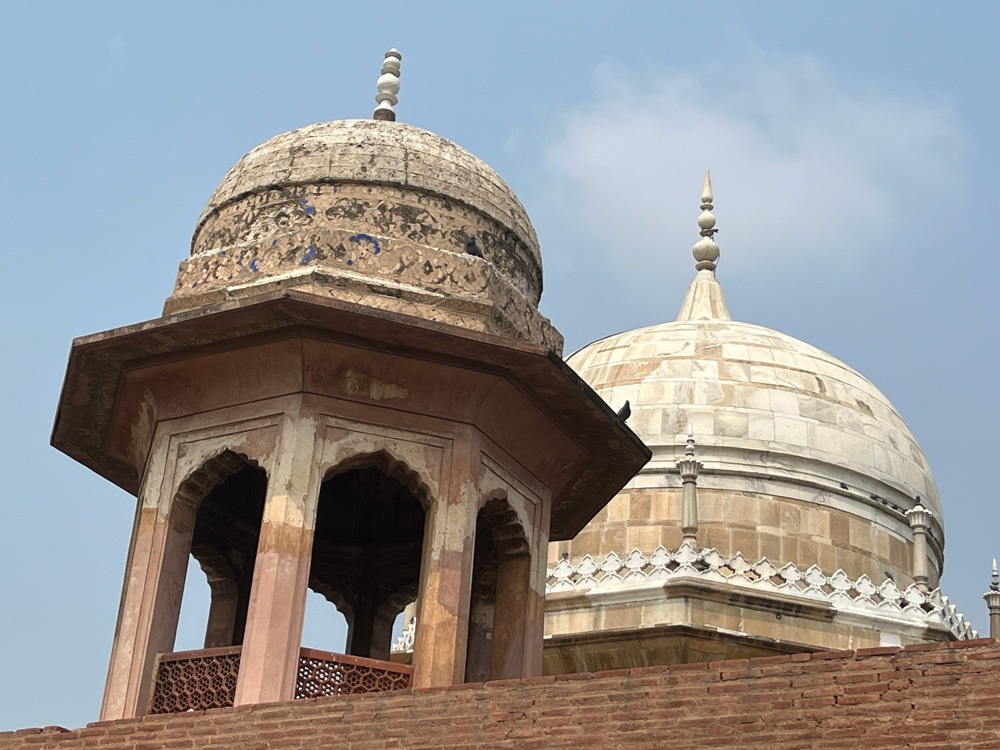 Chattris adorn the monument’s platform. One can still see traces of the original glazed blue, purple and green tiles
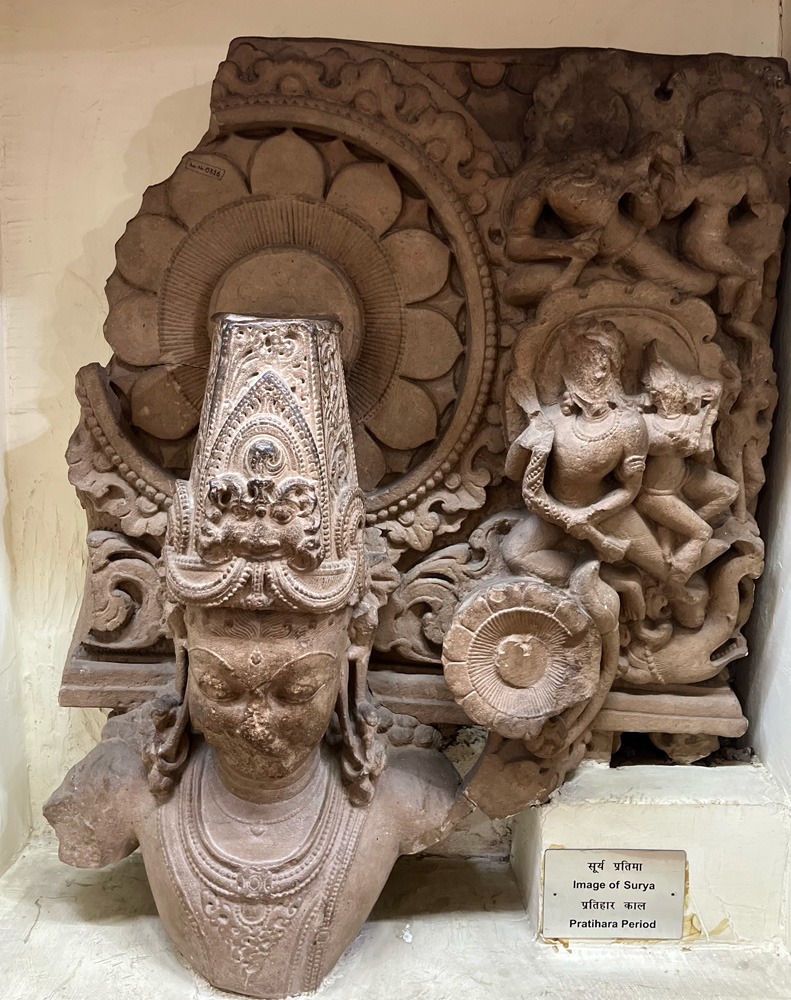 Museum displays from the Rajput era: centuries of India history within meters of each other
 An older dargah in the shadows of Shiekh Chilli
From the terrace of Shiekh Chilli’s complex, I could see a small, single-domed building in the distance, painted pure white and set in the middle of rolling green meadows. This was the dargah of Jalaluddin Thanesari, a sufi pir who preceded Shiekh Chilli. Thanesari was originally from Balkh, Afghanistan and was a contemporary of Akbar, dying in 1581.
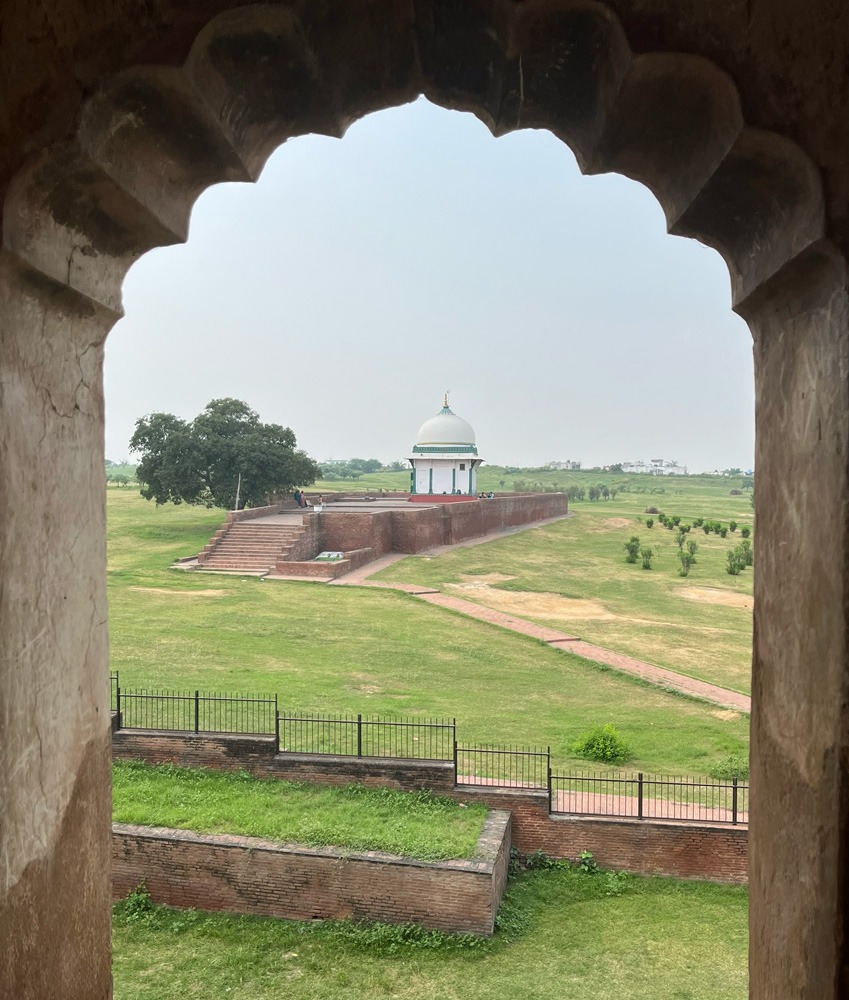 The smaller, older, more intimate dargah of Jalaluddin Thanesari
As I walked up the sloping meadow towards this dargah, I was struck by how small it was compared to the grandeur of the tomb that I had just visited. Shiekh Chilli’s complex had its back towards the dargah, as if deliberately showing where real power resides. In his books, Subhas Parihar has given us a clue on why this could be; for while Jalaluddin Thanesari was a Sufi pir of the Chishti Silsila, Shiekh Chilli belonged to the Qadriya sect of which Dara Shukoh was a disciple. Perhaps this was the prince’s way of proving a point.
A single tree stood beside the dargah, under which a group of pilgrims were sitting. I took off my shoes and walked towards the room. Inside was a grave, covered in a blue chador and surrounded by a wooden fence with one side left open for access. A dozen worshippers, men and women, sat quietly around the grave. The smell of incense filled the air. I could feel the spirituality and quiet reflection.
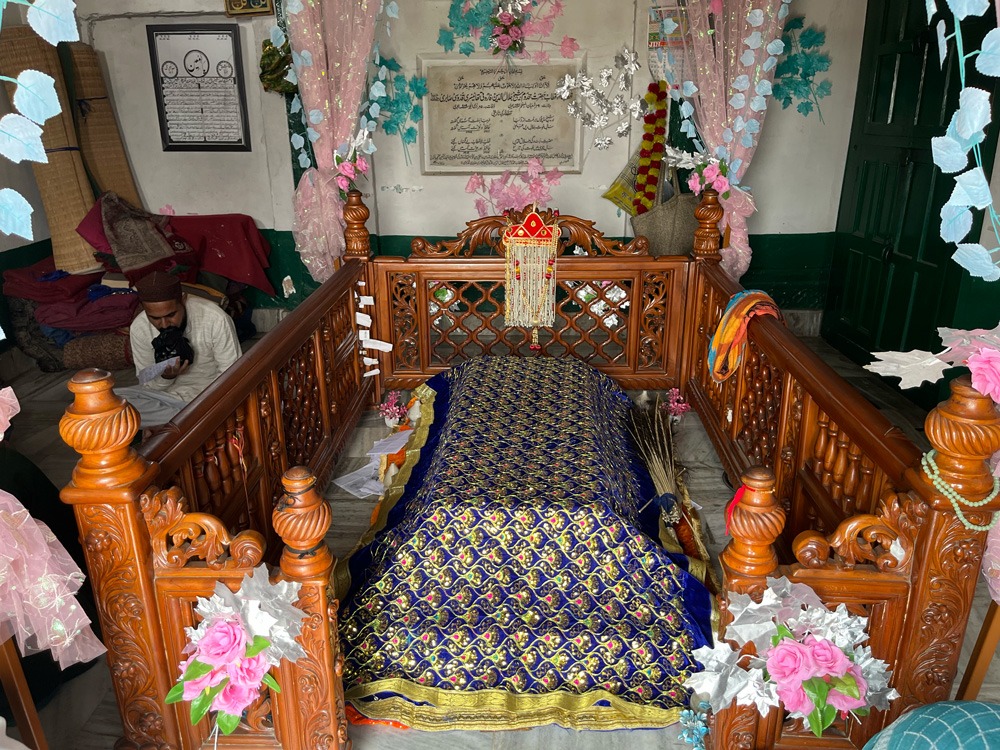
The grave of Sufi pir Jalaluddin Thanesari surrounded by pilgrims sitting in quiet self-reflection
The shimmering, ancient and sacred lake of Brahmo Sarovar
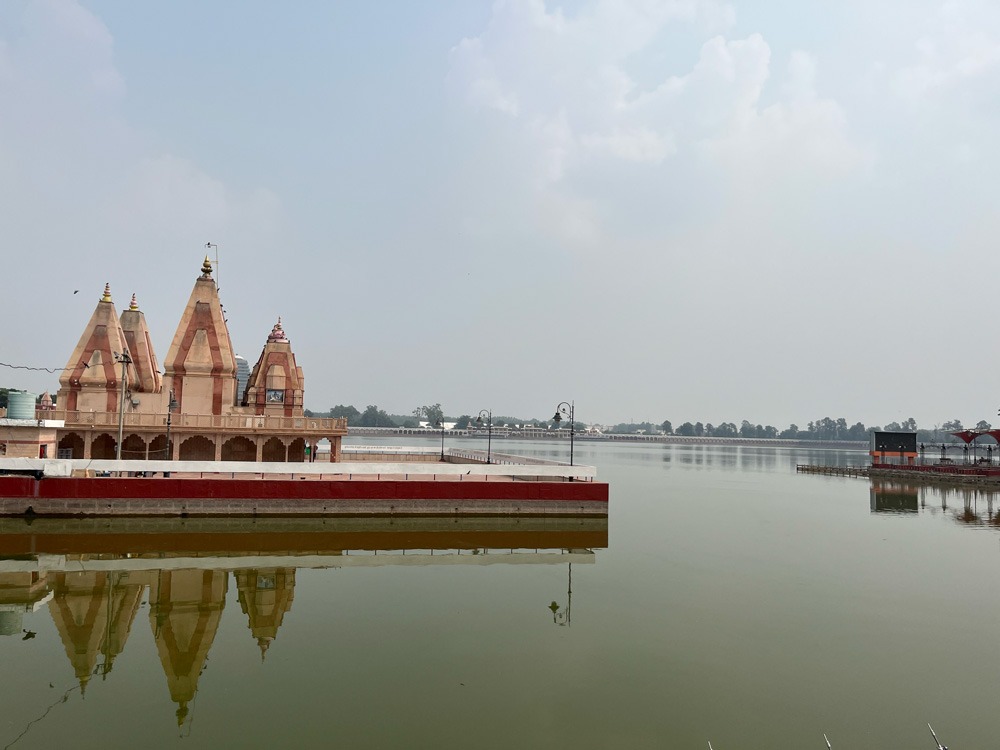
The vast, rectangular sacred lake of Brahmo Sarovar is a pilgrimage site of great importance
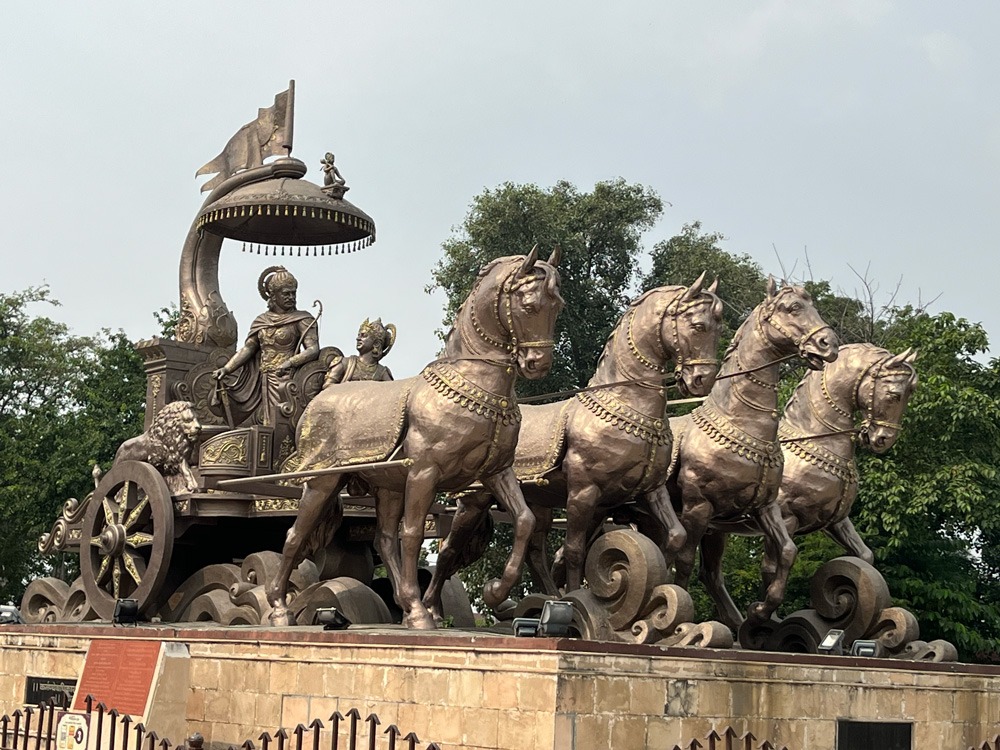 The massive bronze statue at Brahmo Sarovar, depicting Lord Krishna and Arjun
I was standing at a place of huge religious significance. Brahmo Sarovar is believed to be where Lord Brahma performed a yajna to create the universe, and in that manner is seen as the cradle of civilization. It is closely associated with the Mahabharat as Kurukshetra is the land of the great war.
I sat on the wide stone steps of a ghat, taking in the mythological importance. In front and on both sides of me water extended into the distance, its stillness reflecting the sky above. Being the history nerd that I am, I remembered a well-known passage from the 16th century Akbarnama, where the chronicler Abu’l Fazl described an event that occurred here in April 1567, which he called the battle of ascetics. Emperor Akbar was on his way back from Lahore to Agra when he camped at Thanesar, “…near the town there is a tank that may be called a miniature sea”. It was the eve of the solar eclipse and there was a holy fair taking place with a large gathering of ascetics. A dispute arose between two groups of sanyasis over bathing rights, and as the fighting escalated, Akbar had to ask his troops to intervene, coming to this site to “..fling out the jewels of advice”**.
It was late afternoon, and time to drive back to Delhi.
* “Mughal Monuments in the Punjab and Haryana” by Subhas Parihar. Page36
** “Akbaranama” by Abu’l Fazl, translated by H. Beveridge. Volume2, pages 422-423
How to get here:
- From Delhi, take the NH44 north towards Thanesar. It is about a 2.5 hours drive
(90 minutes further from Panipat) - Turn off the highway on to Kurukshetra road
- Keep driving for 4 kms, past the Maharaja Agrasen Chowk, turn on to Jhansa Road for another 1km, and then Shiekh Chilli Marg with the monument to your right.
- The Jalaluddin Thanesari dargah is behind the Shiekh Chilli tomb and within walking distance. So is the Pathar Masjid
- The Brahmo Sarovar is about a 2km drive away.
- Visiting all the Thanesar attractions takes about 4 hours.
- From Delhi, take the NH44 north towards Thanesar. It is about a 2.5 hours drive
Information:
- Parking is available both at Shiekh Chilli tomb (free) and Brahmo Sarovar (Rs 50)
- Sheikh Chilli entry fee is Rs 20.
- Open from sunrise to sunset
- Clean toilets
Sources:
- “Mughal Monuments in the Punjab and Haryana”, by Subhash Parihar Published by Inter-India Publishers, 1985
- “Some Aspects of Indo-Islamic Architecture”. by Subhash Parihar Published by Abhinav Publications
- “Akbaranama” by Abu’l Fazl, translated by H. Beveridge
